Client Acquisition
How to Follow Up on a Proposal: 5 Email Templates That Win Clients
Julius
|December 5, 2025|6 min read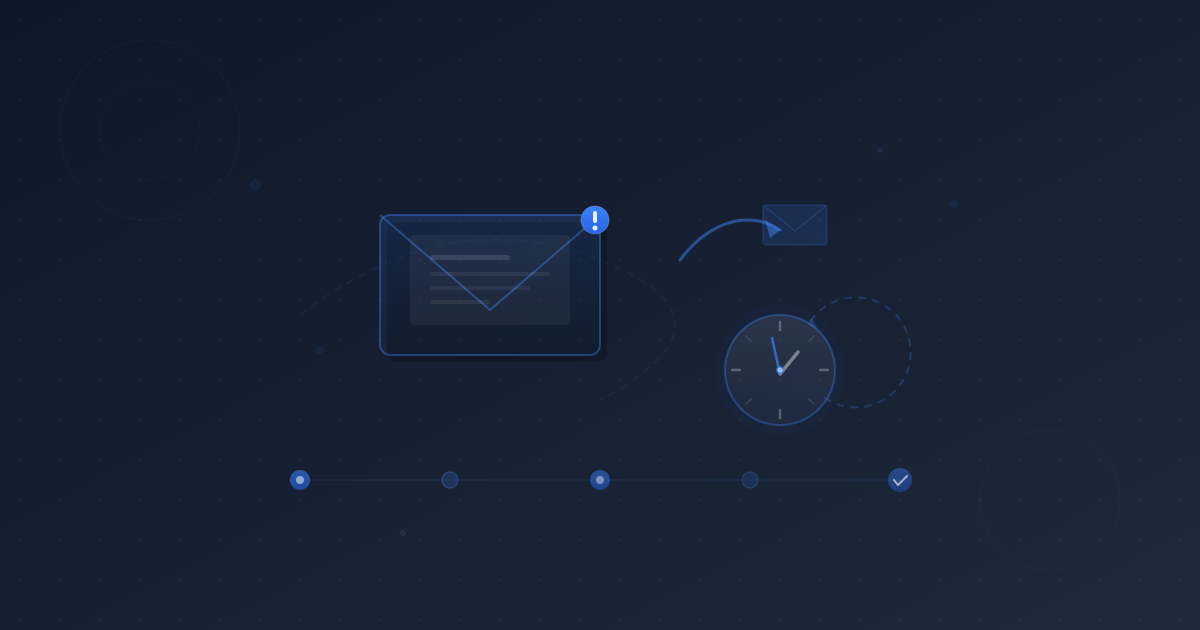
Why Following Up Makes All the Difference
You've written a perfect proposal. Sent it off. And then... silence. Days pass. No response.
Most freelancers give up at this point. That's exactly the mistake.
The numbers speak for themselves:
- 80% of deals require at least 5 touchpoints
- 44% of freelancers give up after the first follow-up
- The average decision takes 2-3 follow-up emails
Following up isn't begging — it's professional diligence. In this article, you'll get 5 proven email templates and a strategy that works.
The Right Timing Strategy
The Follow-Up Schedule
| Timing | Action | Goal | |--------|--------|------| | Day 0 | Send proposal | First impression | | Day 1 | Quick confirmation (optional) | "Did it arrive okay?" | | Day 3-5 | Follow-up 1: Value | New idea, clarify question | | Day 7-10 | Follow-up 2: Social Proof | Case study, reference | | Day 14-21 | Follow-up 3: Urgency | Deadline, capacity | | Day 28+ | Breakup Email | Friendly closure |
When Is the Best Time to Send?
- Tuesday through Thursday — Highest open rates
- 9-10 AM — Before the meeting madness
- 2-3 PM — After lunch
- Avoid Mondays and Fridays — Too many distractions
The 5 Email Templates
Template 1: The Value-Add Follow-Up (Day 3-5)
Subject: Another idea for [Project Name]
Hi [Name],

I've been thinking more about [Project Name] since our
conversation and had an additional idea:

[1-2 sentences about a specific idea or improvement that
wasn't in the proposal]

This could [specific benefit for the client]. If that sounds
interesting, I'd be happy to add it to the proposal.

Any questions about the proposal? Happy to help.

Best regards,
[Your Name]
Why it works: You're offering value instead of asking whether the proposal arrived. This shows engagement and expertise.
Template 2: The Social Proof Follow-Up (Day 7-10)
Subject: How [similar client] achieved [result] with [similar project]
Hi [Name],

I wanted to share a quick example that's relevant
to your project:

We recently completed a similar project for [client name/industry].
The result: [specific outcome, e.g., "40% more inquiries through
the new website"].

[Optional: 1 sentence about what makes the situation comparable]

I'm confident we can achieve a similar result for [Company Name].

Shall we jump on a quick call to discuss next steps?

Best regards,
[Your Name]
Why it works: Social proof reduces perceived risk. The client sees that you've successfully delivered similar projects.
Template 3: The Question Follow-Up (Day 7-10, Alternative)
Subject: Quick question about [Project Name]
Hi [Name],

I want to make sure my proposal matches your expectations
perfectly.

Are there any points in the proposal that are unclear or
that you'd prioritize differently? I'm happy to adjust.

Specifically regarding [specific point from the proposal],
there are different approaches — I'd be glad to walk you
through the options.

Best regards,
[Your Name]
Why it works: You make it easy for the client to re-engage — without pressure. The open question invites a response.
Template 4: The Urgency Follow-Up (Day 14-21)
Subject: Quick update on my availability
Hi [Name],

Quick update: My calendar is filling up for [month/quarter]
and I'm currently planning my upcoming projects.

I want to make sure I reserve enough capacity for
[Project Name] in case you decide to move forward.

Could you let me know by [specific date] whether the
project is happening? I'll hold the time slot for you.

If the project isn't a priority right now, that's
completely fine too.

Best regards,
[Your Name]
Why it works: You create natural urgency (limited capacity) while giving the client a graceful exit.
Template 5: The Breakup Email (Day 28+)
Subject: Should I close the file on [Project Name]?
Hi [Name],

I've reached out a few times about [Project Name] over
the past weeks and I understand other things may have
taken priority.

So I can plan my schedule better: should I close the
file on this project for now?

If things change down the road, don't hesitate to reach
out — I'm always happy to help.

All the best,
[Your Name]
Why it works: The breakup email triggers a psychological effect: nobody wants to lose something. Paradoxically, "giving up" often prompts the client to finally respond.
The Psychology Behind Effective Follow-Ups
1. The Mere-Exposure Effect
The more often someone sees your name, the more positive their perception becomes. Your follow-up isn't harassment — it's brand building.
2. Reciprocity
When you offer value in your follow-up (ideas, case studies, tips), the client feels obligated to at least respond.
3. Loss Aversion
People fear losses more than they value gains. "My capacity is limited" is more powerful than "The price is great."
4. Choice Reduction
Make it easy for the client: Instead of "What do you think?" try "Shall we chat Tuesday or Wednesday for 15 minutes?"
Proposal Tracking: Know When the Client Reads
Your follow-up timing improves dramatically when you know when the client opens your proposal:
- Opened but not responded? → Follow up within 24 hours
- Opened multiple times? → Hot interest — call immediately
- Not opened for days? → Wait 5 days before following up
With Proposal Air, you can see in real-time when and how often your proposal is opened. This lets you follow up at exactly the right moment.
Common Follow-Up Mistakes
"Did you receive my proposal?"
Sounds passive-aggressive. Of course they received it. Offer value instead.
Following Up Too Quickly
Checking in 24 hours after sending the proposal looks desperate. Give the client at least 3 business days.
Too Many Follow-Ups
More than 4 follow-ups without a response will feel like spam. After the breakup email, stop.
Copy-Paste Messages
Each follow-up should bring a new angle: an idea, a reference, a question, a deadline. Don't just "check in again."
Email Only
Sometimes a quick phone call is more effective than three emails. Mix up your channels.
Conclusion: Following Up Is a Skill, Not a Burden
Professional follow-up is the difference between freelancers who wait for projects and those who win them.
The key rules:
- Always offer value — No empty "just checking in" emails
- Respect timing — 3-5 days between follow-ups
- Maximum 3-4 attempts — Then send a breakup email
- Use tracking — Follow up when the client is active
- Mix channels — Email, phone, LinkedIn
Start today: Review your open proposals and send the first follow-up. To see just how powerful a structured follow-up process can be, read the marketing agency case study that increased their close rate from 22% to 58%.
Related reading: The Complete Proposal Writing Guide · 10 Proposal Mistakes to Avoid · How to Find Freelance Clients · Best Proposal Software Compared
Share
About the author
J
Julius
Julius is the founder of Proposal Air. As a former freelancer himself, he knows firsthand how much time proposals eat up — and is building the tool he always wished existed.
Create professional proposals in minutes
With Proposal Air, create stunning proposals — faster, more professional, and AI-powered.
No credit card required
Related Articles
Client Acquisition10 min
Proposal Rejected? How to Respond ProfessionallyProposal turned down? Learn how to respond professionally, gather valuable feedback, and turn every rejection into an opportunity.
Julius
1/21/2026
Client Acquisition13 min
Referral Marketing for Freelancers: How to Build a Systematic Referral Engine65% of freelance projects come through referrals — yet only 12% of freelancers have a systematic referral system. How to make referrals predictable instead of relying on luck.
Julius
2/25/2026
Client Acquisition13 min
LinkedIn Lead Generation for Freelancers: Win Clients Without Cold OutreachHow to win clients on LinkedIn as a freelancer — without spam and without cringe cold outreach. Profile optimization, content strategy, and warm outreach in one system.
Julius
2/21/2026