Case Studies
Case Study: Marketing Agency Increases Close Rate From 22% to 58%
Julius
|January 31, 2026|12 min read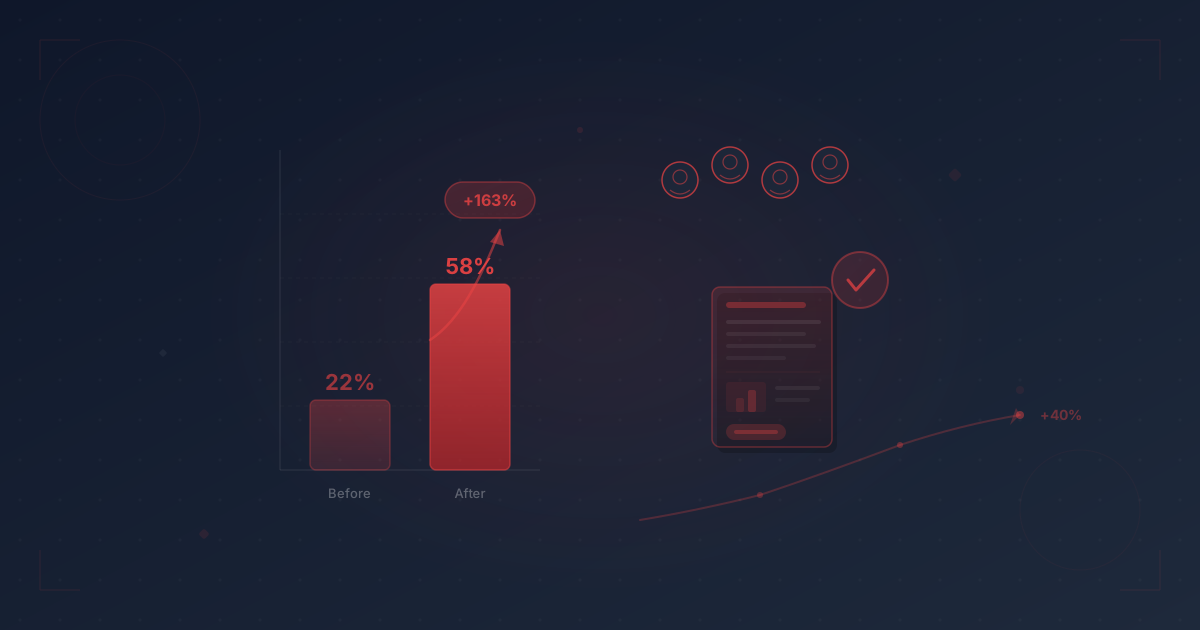
The Agency: Great Work, Poor Proposals
"Digital Spark" (name anonymized) is a 4-person marketing agency based in Hamburg, Germany, specializing in performance marketing and web design for mid-sized B2B companies. Founded in 2021, they had a solid portfolio, satisfied existing clients, and a steady stream of inquiries through referrals and LinkedIn.
On paper, everything looked good. In practice, the situation was frustrating.
Out of 100 annual inquiries, an average of 45 turned into concrete proposals. Of those, just 10 were accepted. That's a close rate of 22% — well below the industry average of 30-35% for marketing agencies.
The consequence: The team spent nearly half their working hours on acquisition, briefings, and proposal creation — for projects that never materialized. Revenue stagnated at 320,000 euros per year, even though they had capacity for significantly more.
The Team
- Laura (Managing Director, Strategy): Responsible for initial client meetings and proposals
- Markus (Performance Marketing): Google Ads, Meta Ads, Analytics
- Sophie (Web Design & UX): Websites, landing pages, conversion optimization
- Tim (Content & SEO): Copywriting, blog articles, SEO strategy
Laura wrote most proposals herself — alongside her roles as strategist and project manager. Each proposal took her 3-5 hours. With 45 proposals per year, that amounted to over 180 hours that translated into fewer than one in four actual projects.
The Analysis: Why Their Proposals Were Failing
In January 2025, Laura decided to tackle the problem systematically. The team analyzed their last 30 lost proposals and, where possible, interviewed former prospects about their reasons for declining.
5 Weaknesses That Kept Surfacing
1. No Lead Pre-Qualification
Digital Spark wrote proposals for anyone who inquired — regardless of budget, timeline, or actual need. Around 40% of proposals went to prospects who were merely "exploring options" or whose budgets fell far short of the project scope.
2. Feature Lists Instead of Customer Value
Their proposals read like technical specifications: "Create and optimize 10 SEA campaigns," "Responsive web design according to current standards," "Monthly reporting with KPIs." What was missing: the concrete business impact for the client. Why would a CEO spend 25,000 euros on "10 SEA campaigns" if they don't understand what that means for their revenue?
3. No Social Proof in the Proposal
Although Digital Spark demonstrably achieved great results for clients — including 200% conversion increases and revenue doublings — there was zero evidence in their proposals. No case studies, no testimonials, no numbers. The prospective client had to trust the agency blindly.
4. Generic Proposal Structure
Every proposal looked the same: cover page, service description, price table, terms and conditions. No individual reference to the client's problem, no personal summary of the initial conversation, no "we understand what you need" moment.
5. No Follow-Up Process
After sending the proposal: nothing happened. Laura waited for a response. If none came after two weeks, she'd send a vague "Have you made a decision yet?" email. After that, the lead was dead.
The Transformation: 4 Phases Over 6 Months
Based on the analysis, the team developed a concrete optimization plan. Implementation took place in four phases between February and July 2025.
Phase 1: Lead Qualification (February 2025)
Goal: Only write proposals when the prospect is genuinely ready to buy.
Measures:
- Qualification questionnaire before the initial call: budget range, timeline, current marketing activities, decision-making process
- Scoring system with 5 criteria (budget, urgency, decision-making authority, fit, previous experience with agencies)
- Threshold: Only leads scoring at least 7 out of 10 receive a customized proposal
- For the rest: Standardized information packages with price ranges and references
Result after Phase 1: The number of proposals dropped from 45 to 28 per year — but lead quality increased dramatically. Instead of 3-5 hours per proposal, Laura invested the freed-up time in fewer but better proposals.
Phase 2: Rethinking Proposal Structure (March-April 2025)
Goal: Proposals that sell, not just inform.
The old structure:
- Cover page with logo
- Service description (bullet points)
- Price table
- Terms and conditions
The new structure:
- Personalized summary — 3-5 sentences showing: "We understand your problem"
- Client problem & goals — What the client said in the initial meeting, in their own words
- Our approach — Not what we do, but why and what results the client can expect
- Concrete results forecast — "Based on comparable projects, we expect a 40-60% increase in inquiries within 6 months"
- Relevant case study — A comparable project with concrete numbers
- Investment with options — Three packages (Basic, Standard, Premium) instead of a single price
- Next steps & timeline — Clear call-to-action with a specific date
The decisive difference: The word "costs" was replaced with "investment." Instead of "10 SEA campaigns," it now read "Projected 150 qualified leads per month through targeted performance marketing."
For a deeper dive into proposal design principles and layout tips, check out our article on designing professional proposals.
Phase 3: Integrating Social Proof (May 2025)
Goal: Build trust through evidence, not promises.
Measures:
- 3 detailed case studies created — one each for the core areas of performance marketing, web design, and content/SEO
- Each case study contained: starting situation, measures taken, results with concrete numbers, and a client quote
- Industry matching: For each new proposal, the case study best matching the prospect's industry was selected
- Testimonial collection: Systematic gathering of client feedback after every successful project — using an email template, no longer "at some point"
Example of an integrated case study in the proposal:
"For MedTech Solutions (B2B medical technology), we increased qualified inquiries through Google Ads by 180% within 4 months — with the same advertising budget. Cost per lead dropped from 89 euros to 34 euros. CEO Dr. Berger: 'Digital Spark exceeded our expectations. The collaboration was efficient, and the results speak for themselves.'"
These few lines carried more weight than three pages of service descriptions. If you're curious about why references are so powerful and want to explore tools that make integrating social proof easy, take a look at our proposal software comparison.
Phase 4: Building a Follow-Up System (June-July 2025)
Goal: No proposal without structured follow-up.
The new follow-up process:
| Day | Action | Channel | |-----|--------|---------| | 0 | Send proposal + short personal message | Email | | 2 | Call: "Did everything arrive? Any questions?" | Phone | | 5 | Follow-up with additional value (industry insight, relevant study) | Email | | 10 | Share a case study or testimonial that fits the client's project | Email | | 15 | Capacity update: "We're planning the next quarter..." | Email | | 21 | Breakup email: "Should we shelve this project for now?" | Email |
The critical element: Every follow-up brought a new angle. Not a single "Have you decided yet?" Instead, always value: a relevant statistic, a fitting blog article, an insight from a comparable project.
The entire system is based on the principles we describe in detail in our guide on following up on proposals — with concrete email templates for every touchpoint.
Before vs. After: A Real Proposal Comparison
To make the difference tangible, here's a real example (anonymized). Prospect: a mid-sized machinery manufacturer looking to improve their digital lead generation.
The Old Proposal (Before Optimization)
Email subject line: "Proposal Digital Spark — Online Marketing"
Contents: 6-page PDF with cover page, 3 pages of service descriptions as bullet points, 1 page price table, 1 page terms and conditions. No reference to the initial conversation. No mention of the client's industry. Total price: 24,000 euros — with no explanation of what the client gets besides "services."
Excerpt:
"Scope of services: Creation and optimization of 8 Google Ads campaigns, conversion tracking setup, monthly reporting, landing page optimization (2 pages), keyword research and monitoring."
The New Proposal (After Optimization)
Email subject line: "Your path to 30+ qualified inquiries per month — our proposal for Mueller Machinery"
Contents: 8-page interactive proposal with personalized summary, concrete results forecast, matching case study from the manufacturing industry, three investment options, and a clear next step.
Excerpt from the summary:
"Mr. Mueller, in our conversation on March 12th, you named two core challenges: Your website currently generates only 3-5 inquiries per month, and your sales team spends too much time on cold outreach instead of working with qualified leads. Our goal: Increase your monthly qualified inquiries to 30+ within 6 months — at a calculable cost per lead under 40 euros."
Excerpt from the results forecast:
"Based on our project with TechParts GmbH (also machinery manufacturing, comparable starting situation), we expect: Months 1-2: Setup and initial campaigns, 10-15 inquiries/month. Months 3-4: Optimization, 20-25 inquiries/month. Months 5-6: Scaling, 30+ inquiries/month."
The difference is obvious: the old proposal described what the agency does. The new proposal described what the client gets out of it.
The Results After 6 Months
From August 2025 to January 2026, Digital Spark tracked all relevant metrics. The numbers tell a clear story.
Close Rate
| Metric | Before (2024) | After (Aug 2025 - Jan 2026) | Change | |--------|---------------|-------------------------------|--------| | Total inquiries | 100 | 95 | -5% | | Qualified leads | 45 | 32 | -29% | | Proposals sent | 45 | 28 | -38% | | Proposals accepted | 10 | 16 | +60% | | Close rate | 22% | 58% | +163% |
The close rate climbed from 22% to 58%. Fewer proposals, but significantly more won projects.
Revenue and Efficiency
| Metric | Before (2024) | After (Annualized) | Change | |--------|---------------|----------------------|--------| | Annual revenue | 320,000 EUR | 448,000 EUR | +40% | | Average project value | 32,000 EUR | 28,000 EUR | -12% | | Hours per proposal | 4.5h | 3h | -33% | | Total proposal time/year | 202h | 84h | -58% | | Projects won | 10 | 16 (annualized) | +60% |
Revenue increased by 40% — even though the average project value decreased slightly. This was because the new three-tier package structure (Basic, Standard, Premium) attracted more mid-sized projects that would have previously fallen through the cracks.
The time savings were massive: 118 fewer hours per year on proposal creation. That's nearly 3 work weeks that Laura now invests in strategy and client management.
Additional Effects
- Average decision time: Shortened from 18 days to 9 days
- Proposal revisions: From 2.3 revisions per proposal down to 0.8 — because the initial proposal was a better fit
- Referral rate: 4 of the 16 won projects came through referrals from clients who had forwarded the professional proposal
- Price negotiations: Significantly less frequent. Value framing made price secondary
What Other Agencies Can Learn From This
Digital Spark's transformation wasn't coincidence or a one-off. The principles work across industries. Here are the key takeaways for agencies and freelancers who want to improve their close rate.
1. Write Fewer Proposals, But Better Ones
The most counterintuitive step was also the most effective: writing fewer proposals. Lead qualification ensured that Laura focused her energy on prospects who were genuinely ready to buy. If you're looking for a structured approach to client acquisition, put qualification first.
2. Sell Outcomes, Not Services
No decision-maker buys "10 Google Ads campaigns." They buy "30 qualified inquiries per month." The shift from feature lists to outcome projections was the most powerful lever in proposal optimization. Value-based pricing requires this perspective shift — away from "What does my time cost?" toward "What is the outcome worth?"
3. Social Proof Is Not Optional
Every proposal without references is a leap of faith the client has to take. With case studies and testimonials, you measurably lower the decision barrier. Three relevant references are enough — but they must match the prospect's industry and project type.
4. Follow-Up Is Not Begging
The structured follow-up process was Digital Spark's second most powerful lever after proposal restructuring. 5 of the 16 won projects only came through after the second or third follow-up. Without the system, those clients would have been lost.
5. Three Price Options Instead of One Fixed Price
The package structure (Basic, Standard, Premium) achieved a dual effect: First, the prospect no longer had to decide "yes or no" but rather "which package fits best?" Second, 62% of clients chose the middle package — exactly as the agency had planned.
6. Proposals Are Work Samples
A professionally designed proposal says more than any reference. It tells the client: "This is how we work. Structured, thoughtful, on point." Digital Spark invested in a consistent proposal design — and received feedback multiple times that the proposal alone had been the deciding factor.
Conclusion: Systems Beat Talent
Digital Spark's story shows that a poor close rate isn't fate. It's a symptom of a proposal process that hasn't been optimized. And the solution isn't "selling better" — it's thinking through the entire process from first contact to follow-up, systematically.
The 5 most important steps summarized:
- Qualify leads before writing a proposal — save time for the right prospects
- Structure proposals around client value, not your services
- Integrate social proof — at least one industry-relevant case study per proposal
- Build a follow-up process with 4-6 touchpoints and concrete added value
- Offer three pricing options instead of a single fixed price
With these measures, Digital Spark increased revenue by 40%, cut proposal creation time in half, and raised their close rate from 22% to 58%. And the best part: none of these measures required additional staff or a bigger marketing budget. Just a better system.
Related reading: How to Follow Up on a Proposal · Best Proposal Software Compared · Designing Professional Proposals · How to Find Freelance Clients
Share
About the author
J
Julius
Julius is the founder of Proposal Air. As a former freelancer himself, he knows firsthand how much time proposals eat up — and is building the tool he always wished existed.
Create professional proposals in minutes
With Proposal Air, create stunning proposals — faster, more professional, and AI-powered.
No credit card required
Related Articles
Case Studies12 min
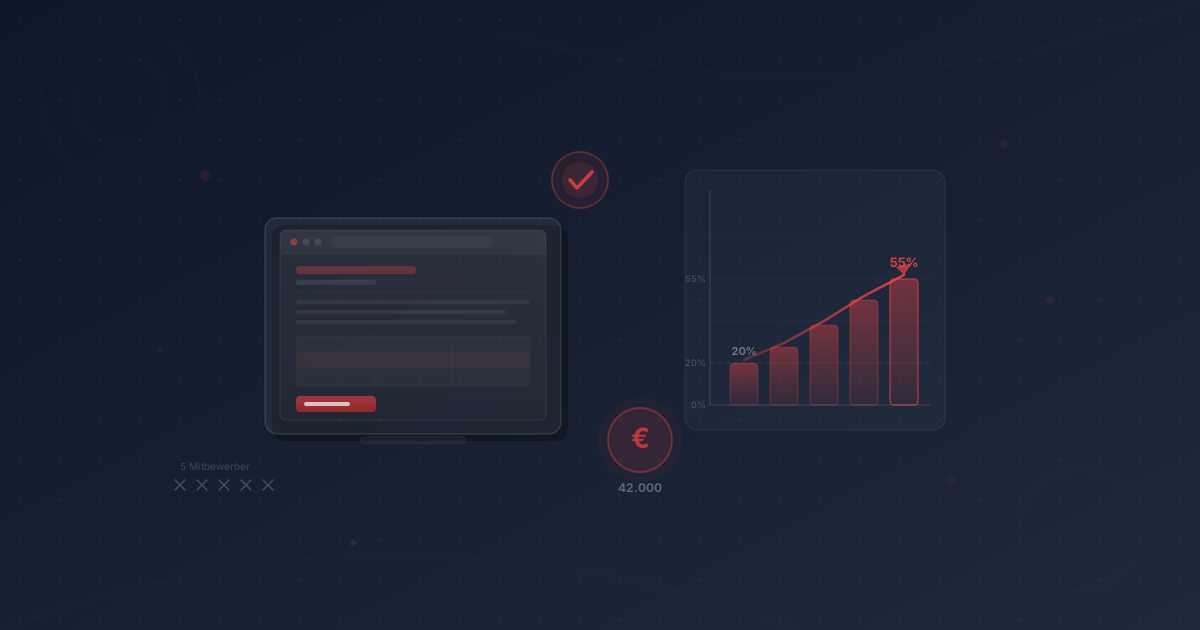
Case Study: How a Web Designer Won a €42,000 Project Against 5 CompetitorsHow freelance web designer Marco increased his proposal conversion from 20% to 55% and won a €42,000 project against 5 competitors. With concrete before/after comparison.
Julius
1/28/2026
Case Studies15 min
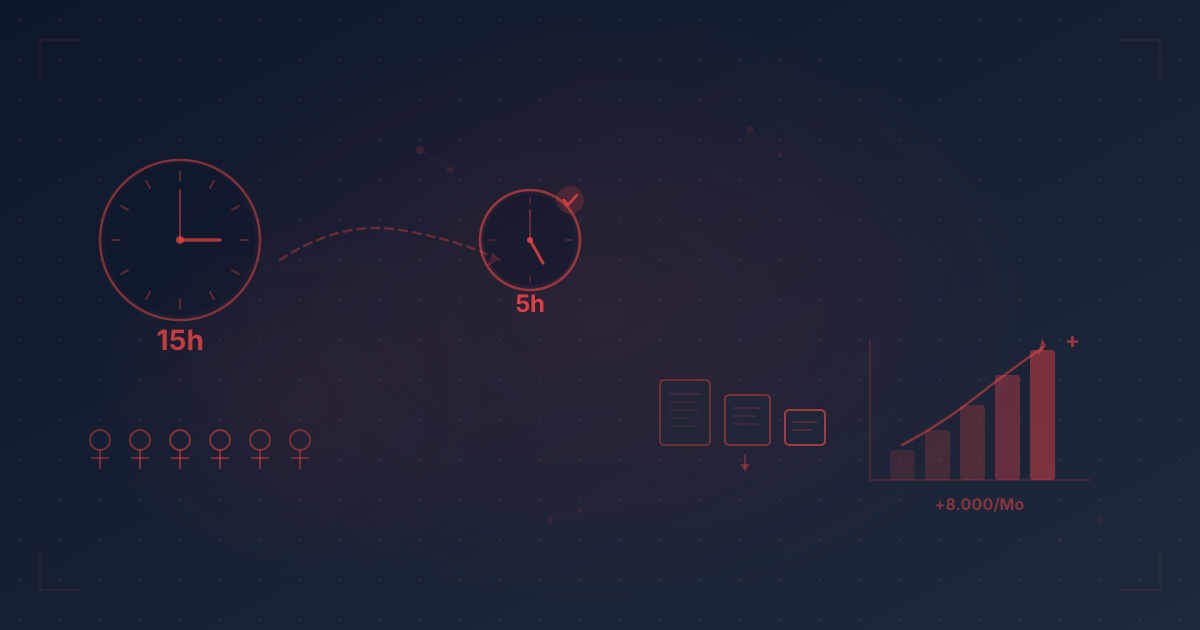
Case Study: Design Agency Saves 15 Hours Per Week on Proposal CreationHow a 6-person design agency reduced their proposal process from 15+ hours/week to under 5 hours — and turned the freed-up time into 8,000 euros/month in additional revenue.
Julius
2/11/2026
Case Studies12 min
Case Study: How a Copywriter Scaled Revenue From €48k to €112kHow freelance copywriter Lisa scaled her revenue from €48k to €112k — through proposal automation, package pricing, and less admin work. The complete strategy.
Julius
2/7/2026