Case Studies
Case Study: How a Copywriter Scaled Revenue From €48k to €112k
Julius
|February 7, 2026|12 min read
Starting Point: Great Copywriter, Broken Business Model
Lisa (name anonymized) is a freelance copywriter based in Berlin. She writes website copy, blog articles, and landing pages for mid-sized companies. Her work is solid — clients come back, refer her to others, and the reviews speak for themselves.
Yet in 2025, Lisa earned just €48,000 gross. At an hourly rate of €65 and roughly 40 working hours per week, that might not sound terrible. But the math has a catch: of those 40 hours, only 28 were billable. The remaining 12 hours? Administrative work.
Lisa's problem was not the quality of her writing. Her problem was that she spent 30% of her time on tasks that generated zero revenue:
- Writing and formatting proposals
- Reading briefs and clarifying requirements
- Following up on outstanding proposals
- Drafting and exchanging contracts
- Writing invoices and tracking payments
Sound familiar? You are not alone. Studies show that freelancers spend an average of 20-35% of their working time on administration. At a 40-hour week, that is up to 14 hours that never get billed.
This case study shows how Lisa grew her revenue from €48,000 to €112,000 within 12 months — while working fewer hours per week. No magic, no secret hacks. Just four systematic changes.
The Analysis: Where Does the Time Go?
Before changing anything, Lisa tracked her time meticulously for two weeks. Every task, every minute. The results were sobering — and at the same time, the turning point.
Lisa's Time Allocation (Before)
| Activity | Hours/Week | Share | Billable? | |----------|-----------|-------|-----------| | Writing copy | 22h | 55% | Yes | | Project research | 6h | 15% | Partially | | Creating proposals | 4h | 10% | No | | Follow-ups and communication | 3h | 7.5% | No | | Invoicing and bookkeeping | 2h | 5% | No | | Contracts and formalities | 1.5h | 3.75% | No | | Acquisition and networking | 1.5h | 3.75% | No | | Total | 40h | 100% | 28h (70%) |
The numbers told a clear story: 12 hours per week went to activities that generated no direct revenue. At an hourly rate of €65, that translated to a theoretical revenue loss of €780 per week — or €40,560 per year.
But the actual loss was even greater. Those admin hours often fell during her most productive time: Monday morning writing proposals instead of working on client projects. Friday afternoon sending invoices instead of preparing the next job.
The single biggest time drain: proposal creation. Lisa needed an average of 45 minutes per proposal. With 5-6 proposals per week, that added up to 4-5 hours — time she could have been billing.
Step 1: Automate the Proposal Process
The first and most impactful step was automating proposal creation. Until then, Lisa had written every proposal from scratch: drafting the scope of work, sketching a timeline, calculating prices, formatting everything into a polished PDF, and sending it by email.
Before: 45 Minutes Per Proposal
Lisa's old proposal process looked like this:
- Read the client's brief (5 min)
- Define and write the scope of work (15 min)
- Calculate pricing and list line items (10 min)
- Format the proposal in Word/Canva (10 min)
- Export as PDF and send via email (5 min)
Total time: 45 minutes per proposal
At 5 proposals per week: 3.75 hours on proposal creation alone. And that was a conservative estimate — for more complex projects, it could easily take 60-90 minutes.
After: 5 Minutes Per Proposal
With an AI-powered proposal tool, Lisa fundamentally changed her process. Instead of building each proposal from zero, she used templates for her most common services and let the AI handle the rest:
- Summarize the project brief in 2-3 sentences (1 min)
- AI generates a complete proposal with scope, pricing, and timeline (1 min)
- Review the proposal, adjust if needed (2 min)
- Send directly from the tool, including digital signature (1 min)
Total time: 5 minutes per proposal
That is a reduction of 89%. At 5 proposals per week, Lisa immediately saved 3.3 hours per week — or approximately 170 hours per year.
But the time savings were only the obvious benefit. The more important side effect: Lisa's proposals looked more professional. Consistent design, clear structure, transparent pricing. This had a direct impact on her conversion rate — more on that later.
If you are still handling your proposal process manually, our proposal template guide is a good starting point. Or you can skip straight to automation and save yourself the detour through manual templates.
Step 2: From Hourly Rates to Package Pricing
The second major lever was switching from hourly billing to package pricing. Lisa previously charged €65 per hour. The result: clients constantly asked how long things would take. Lisa felt pressured to work fast. And the more efficient she became, the less she earned.
The paradox of hourly billing: efficiency gets punished. If Lisa used to need 10 hours for a blog article and now only needed 6, she earned 40% less — even though the quality stayed the same or even improved.
The solution: three clearly defined packages that reflect the value of the deliverable rather than the time invested. If you want to dive deeper into rate calculation, our freelance rate calculator can help.
Lisa's Package Structure
Starter Package — €890
- 1 landing page OR 3 blog articles (800-1,200 words each)
- Basic keyword research
- 1 revision round
- Delivery within 10 business days
Standard Package — €2,400
- Complete website copy (up to 7 pages)
- SEO keyword research and optimization
- 2 revision rounds
- Meta descriptions and title tags
- Delivery within 15 business days
Premium Package — €4,800
- Website copy (up to 12 pages)
- Content strategy with editorial calendar (3 months)
- SEO optimization with competitor analysis
- 3 revision rounds
- 4 blog articles as content foundation
- Delivery within 20 business days
Why Packages Work Better
The switch produced several effects simultaneously:
1. Higher margins. The Standard Package at €2,400 took Lisa about 24 working hours. Effectively: €100/hour instead of €65/hour. For the Premium Package, the effective hourly rate reached €109.
2. Predictability for the client. Instead of "it depends on how long it takes," Lisa could say: "The Standard Package costs €2,400 and includes everything you need." No risk, no surprises.
3. Upselling effect. Clients who initially only wanted a single blog article often booked the Starter Package or even the Standard Package after the conversation. The package structure made the added value visible.
4. Fewer price negotiations. With hourly rates, clients love to haggle. With packages, they either accept the price or choose a smaller package. The discussion shifts from "Can you lower your hourly rate?" to "Which package fits best?"
The average order value rose from €650 (10 hours x €65) to €2,100 — an increase of 223%.
Step 3: Systematize Follow-Up
A problem Lisa had long underestimated: lost proposals due to missing follow-ups. Out of 20 proposals per month, 8-10 regularly went unanswered. Lisa sent the proposal, waited — and then forgot to follow up. Or she found it uncomfortable to "pester" the client.
The data told a different story: 80% of contracts require at least one follow-up. Not following up meant Lisa was systematically leaving money on the table.
Before: Manual, Inconsistent Follow-Up
- No system, no overview of outstanding proposals
- Follow-up only when Lisa happened to remember
- Often too late (after 2-3 weeks instead of 3-5 days)
- Uncomfortable feeling when following up ("I don't want to annoy the client")
Result: 25% conversion rate (5 contracts from 20 proposals)
After: Automated Follow-Up Sequence
Lisa set up a three-part follow-up sequence:
Day 3: Short, friendly reminder ("Did my proposal reach you? Any questions?")
Day 7: Content-driven value add ("Here's an example of a similar project I recently completed...")
Day 14: Final message with a gentle deadline ("The proposal is valid until the end of the week. Would you like me to adjust anything?")
The best part: the follow-ups were sent automatically. Lisa no longer had to remember, no longer had to wonder whether she was writing "yet again." The system took over.
Result: Conversion rate climbed to 42% (8-9 contracts from 20 proposals)
That is 3-4 additional contracts per month — without more outreach, without more proposals. Simply because existing proposals were followed up consistently. For more on follow-up strategy, see our article How to follow up on proposals: The complete guide.
Step 4: Attract Higher-Value Clients
The final piece in Lisa's transformation was not a tool or a tactic — it was a strategic decision: attract better clients instead of more clients.
Lisa's old client mix was typical for early-stage freelancers: many small jobs, price-sensitive clients, frequent one-off projects. The package switch had already increased her average order value. But the decisive effect came from her improved professional image.
How Better Proposals Attract Better Clients
Professional proposals act as a filter. A cleanly structured, visually appealing proposal with transparent pricing and a clear scope of work sends a message: "This is someone who knows what they're doing."
This attracted a new type of client:
- Mid-sized companies instead of solopreneurs with minimal budgets
- Marketing departments instead of CEOs who "occasionally need some copy"
- Long-term partnerships instead of one-off projects
- Clients who value quality instead of clients who count hours
The Compound Effect
The four steps reinforced each other:
-
Faster proposal creation meant: Lisa could handle more inquiries and respond faster. Sending a professional proposal within 2 hours wins the contract more often than someone who needs 3 days.
-
More professional proposals meant: higher-value clients took Lisa seriously. The conversion rate kept climbing.
-
Package pricing meant: higher order volumes with fewer individual jobs. Lisa no longer needed 8 clients per month — 4-5 were enough.
-
Systematic follow-up meant: no contract slipped through the cracks. The conversion rate rose from 25% to 42%.
For a comprehensive overview of automating your freelance business processes, check out our automation guide for freelancers. And if you want to explore integrating AI tools into your daily workflow, our AI tools guide for freelancers is worth a read.
Results After 12 Months
Twelve months after starting the transition, Lisa's business looked fundamentally different. Here are the concrete numbers side by side:
Financial Metrics
| Metric | Before | After | Change | |--------|--------|-------|--------| | Annual revenue (gross) | €48,000 | €112,000 | +133% | | Monthly revenue (average) | €4,000 | €9,333 | +133% | | Effective hourly rate | €65 | €104 | +60% | | Average order value | €650 | €2,100 | +223% |
Time Investment
| Metric | Before | After | Change | |--------|--------|-------|--------| | Working hours/week | 40h | 34h | -15% | | Billable hours/week | 28h | 30h | +7% | | Admin hours/week | 12h | 4h | -67% | | Admin share | 30% | 12% | -18 percentage points | | Time per proposal | 45 min | 5 min | -89% |
Business Metrics
| Metric | Before | After | Change | |--------|--------|-------|--------| | Proposals/month | 20 | 18 | -10% | | Conversion rate | 25% | 42% | +68% | | Contracts/month | 5 | 7-8 | +50% | | Average project duration | 1 week | 2-3 weeks | Higher-value projects | | Returning clients | 20% | 45% | +125% |
The Number That Matters Most
Lisa now works 6 fewer hours per week than before — and earns €64,000 more per year. For every admin hour she eliminated, she effectively reclaimed €1,538 per year.
Put differently: the investment of roughly €50/month in automation tools generated a return of over €5,000 per month in additional revenue. That is an ROI exceeding 10,000%.
Key Takeaways: What Other Freelancers Can Learn
Lisa's story is not an isolated case. The principles behind her revenue growth apply to virtually any freelance discipline — whether you are a designer, developer, consultant, or translator.
1. Track Your Time With Brutal Honesty
You cannot optimize what you do not measure. Most freelancers massively underestimate their admin overhead. Two weeks of consistent time tracking is enough to identify the biggest time drains. And more often than not, proposal creation is right at the top of the list.
2. Automate the Proposal Process First
Of all possible automations, proposal creation delivers the highest ROI. The reason: it affects every single potential contract. Every minute you save here multiplies across all proposals for the year.
3. Switch From Hourly Rates to Package Pricing
Package pricing is not a gimmick — it is the logical consequence of value-based thinking. Your client is not buying a block of hours. They are buying an outcome: a website that converts, a blog article that ranks, a landing page that generates leads. Price the outcome, not the time.
4. Systematize Your Follow-Up
Not following up is the same as burning money. Most contracts require at least one reminder. Automated follow-up sequences remove the awkwardness and ensure that no proposal gets forgotten.
5. Invest in Your Professional Image
Professional proposals are your business card. They determine whether you are perceived as a "budget freelancer" or an "expert with a clear process." Investing in better tools and processes pays off not just in time savings — it changes the caliber of clients who book you.
Your Next Step
You do not have to implement all four steps at once. Lisa did not change everything overnight either. But she started — and she started with the step that had the greatest immediate impact: automating her proposal creation.
If you change just one thing today, make it this: stop writing every proposal from scratch. Use templates, use automation, use AI. The 40 minutes you save per proposal are 40 minutes more for the work that actually moves your business — and your clients — forward.
Related articles: How to calculate your freelance rate · Freelancer automation: Save 10h/week · AI tools for freelancers 2026 · Proposal template for freelancers
Share
About the author
J
Julius
Julius is the founder of Proposal Air. As a former freelancer himself, he knows firsthand how much time proposals eat up — and is building the tool he always wished existed.
Create professional proposals in minutes
With Proposal Air, create stunning proposals — faster, more professional, and AI-powered.
No credit card required
Related Articles
Case Studies15 min
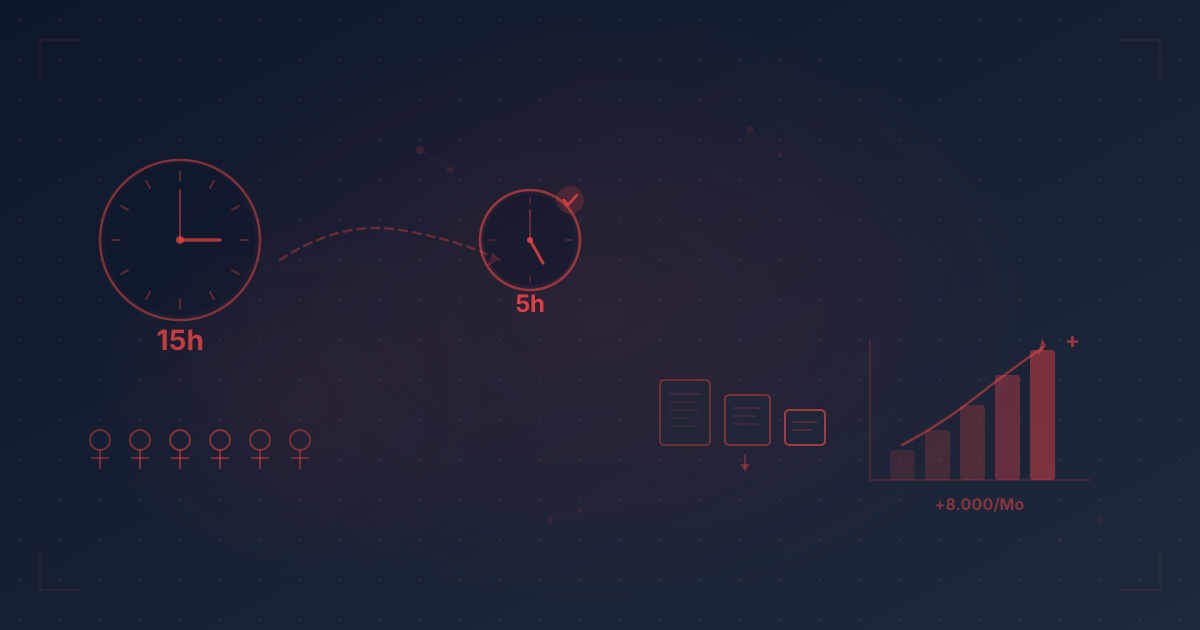
Case Study: Design Agency Saves 15 Hours Per Week on Proposal CreationHow a 6-person design agency reduced their proposal process from 15+ hours/week to under 5 hours — and turned the freed-up time into 8,000 euros/month in additional revenue.
Julius
2/11/2026
Case Studies13 min
Case Study: IT Consultant Reaches €18,000/Month With Retainer ModelHow IT consultant Stefan went from unpredictable one-off projects to a predictable €18,000/month in retainer revenue — through strategic proposal design with tiered packages.
Julius
2/4/2026
Case Studies12 min
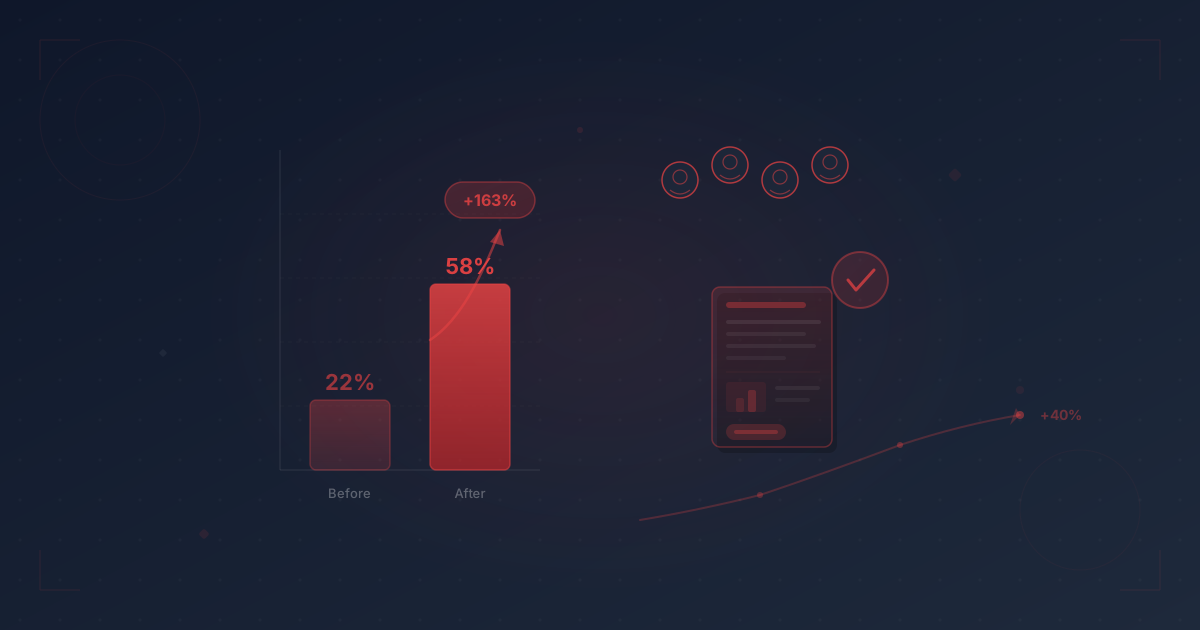
Case Study: Marketing Agency Increases Close Rate From 22% to 58%How a 4-person marketing agency increased their close rate from 22% to 58% — through systematic proposal optimization, social proof, and follow-up automation.
Julius
1/31/2026