Case Studies
Case Study: Design Agency Saves 15 Hours Per Week on Proposal Creation
Julius
|February 11, 2026|15 min read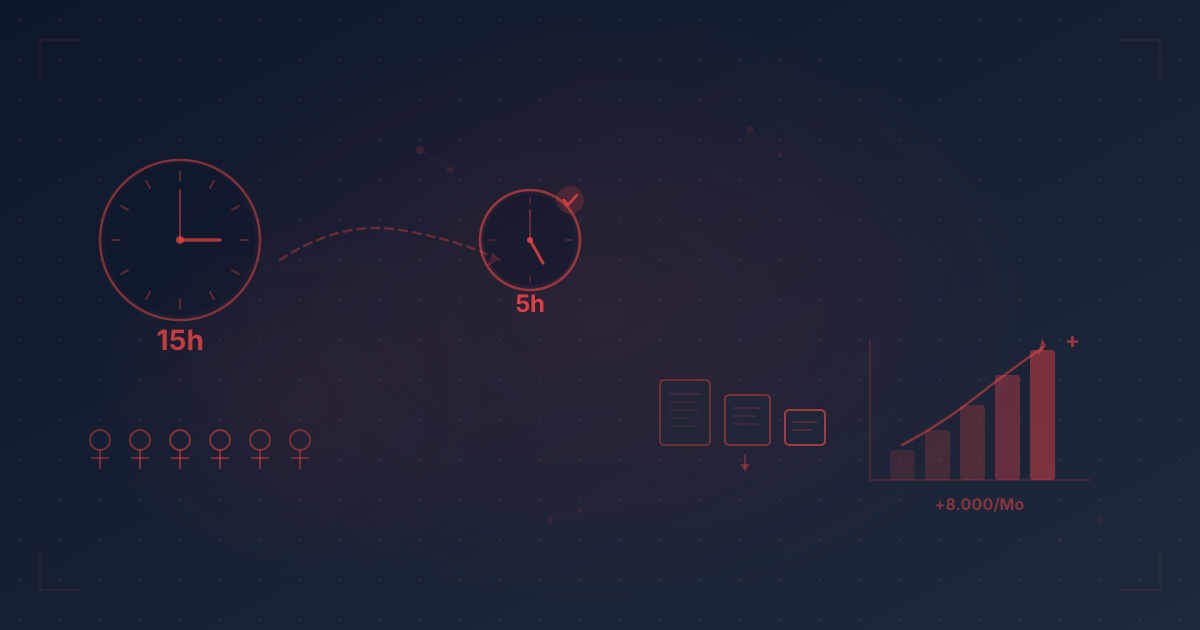
Proposal Creation: The Silent Productivity Killer
If you run a design agency, you know the problem: you win clients with creative work, but a staggering portion of your week goes into administrative tasks. At the top of the list: writing proposals.
This is the story of "Kreativwerk" — a 6-person design agency based in Cologne, Germany, that reduced their proposal process from 15-20 hours per week to under 5 hours. The freed-up capacity generated 8,000 euros in additional monthly revenue. No theory, no guesswork — a documented transformation process over 12 weeks.
What this case study covers:
- The unvarnished assessment: where exactly the time was being lost
- The 3-phase plan: from templates to AI to digital workflows
- The 4-week implementation: step by step and fully reproducible
- Results after 3 months: hard numbers and soft factors
- ROI calculation: what the transition actually delivered
Note: "Kreativwerk" is an anonymized name. The numbers and process are real — the agency requested anonymization.
The Starting Problem: 15 Hours Per Week on Proposals
Kreativwerk is a typical design agency in the DACH region: 6 employees, specializing in brand design, web design, and digital campaigns. The client roster is solid — mid-market companies that value quality and are willing to pay for it.
The problem wasn't the pipeline. The problem was the time between receiving an inquiry and getting a signed proposal.
The Typical Weekly Schedule — Before
Here's what an average week looked like at Kreativwerk, just for proposal-related work:
| Day | Activity | Time Spent | |-----|----------|------------| | Monday | 2-3 initial meetings with potential clients, gathering requirements | 3 hours | | Tuesday | Client project research, competitive analysis | 2 hours | | Wednesday | Writing service descriptions, calculating prices | 4 hours | | Thursday | Proposal layout, inserting references, QA | 3 hours | | Friday | Internal alignment, revision rounds, PDF export, sending | 3 hours |
Total weekly effort: 15 hours — split between the managing director (about 10 hours) and the project manager (about 5 hours). With an average of 4-6 proposals per week, that meant each individual proposal consumed 2.5-3.5 hours.
For context: the agency's average hourly rate was 120 euros. Those 15 hours of proposal work per week represented a potential revenue loss of 1,800 euros — every single week.
The Four Time Drains in Detail
The analysis revealed four main areas where time was being lost:
1. Research and Brief Preparation (20% of time)
For every proposal, the managing director had to research the client context: industry, competitors, existing brand presence. Even though many clients came from similar industries, this research was done from scratch every time. There was no structured knowledge base.
2. Writing Service Descriptions (35% of time)
The single biggest line item. Every service description was written individually — even though 70-80% of the content was identical for comparable projects. A web design proposal always included wireframing, UI design, responsive implementation, and testing. Yet these sections were rewritten every time. Tips on professional proposal design were known but implementing them consistently failed due to lack of a system.
3. Layout and Design (25% of time)
Kreativwerk held themselves to the standard that proposals should look as polished as their design work. Understandable — but that meant every proposal was designed in InDesign with custom covers, embedded reference projects, and tailored infographics. A high quality bar that consumed enormous amounts of time.
4. Alignment, Revisions, and Sending (20% of time)
Internal review rounds between the managing director and project manager. Revision cycles after feedback. Export as PDF. Sending via email with a cover letter. Following up to confirm the proposal arrived. Tracking whether it was opened — manually, by asking. The topic of properly following up on proposals was a constant pain point.
The Assessment: Where Is the Optimization Potential?
Before Kreativwerk changed anything, the team conducted an honest analysis. For two weeks, every minute spent on proposals was documented. The result was sobering — but also encouraging, because it revealed clear levers.
The 80/20 Realization
Of the 15 hours per week, only about 3-4 hours were truly value-creating — meaning work that required individual expertise and creativity:
- Strategic positioning of the proposal
- Custom pricing based on project risks
- Personal communication and relationship building
The remaining 11-12 hours consisted of repetitive tasks that could be standardized or automated. That was the turning point: not everything needed to be faster — only the right things needed to be eliminated.
The Benchmark Question
The managing director asked himself a simple question: "How long should a proposal take at most if we designed the process perfectly?"
The answer: 30-45 minutes per proposal. One-third to one-fifth of the current time. With 4-6 proposals per week, that would mean 3-4.5 hours — instead of 15-20.
The Solution: The 3-Phase Plan
Kreativwerk chose evolution over revolution. Three phases, each building on the previous one, implemented over a total of 4 weeks.
Phase 1: Modular Templates (Weeks 1-2)
The first and most important measure: instead of starting every proposal from a blank page, the team built a modular building-block system.
The Building Blocks:
- Introduction module: 5 variants for different industries (e-commerce, B2B services, startups, hospitality/retail, manufacturing)
- Service modules: Standardized descriptions for all core services — brand design, web design, social media, print, campaigns. Each module in three levels of detail: short (3 sentences), medium (1 paragraph), detailed (half page)
- Reference module: 15 prepared case studies from past projects, categorized by industry and service type
- Pricing module: Predefined pricing structures (fixed price, hourly, retainer) with placeholders for individual calculations
- Closing module: Standardized sections on timelines, payment terms, and next steps
Phase 1 result: Pure text creation dropped from 5-6 hours to 1-2 hours per week. Instead of writing copy, the team assembled and customized building blocks. If you don't have templates yet, our proposal template guide is a good starting point.
Phase 2: AI Integration for First Drafts (Weeks 2-3)
The modular templates were a major leap. But Kreativwerk wanted to go one step further: AI should generate a complete proposal draft from a short brief.
The Workflow:
- Managing director conducts initial meeting and notes 5-10 bullet points
- Bullet points are fed into the AI proposal generator
- AI creates a complete draft based on templates and the brief
- Managing director reviews and customizes (10-15 minutes instead of 60-90 minutes)
What AI handled:
- Selecting the right template modules based on project type
- Drafting the project-specific introduction
- Assembling the service description with industry-specific adjustments
- Suggesting a pricing structure based on comparable projects
- Generating a realistic timeline
What AI did not handle:
- Final pricing calculation (too sensitive for automation)
- Strategic positioning against competitors
- Personal client communication and relationship building
- Quality control of the overall proposal
Phase 2 result: Creation time per proposal dropped from 30-40 minutes (with templates) to 15-20 minutes (with AI support). For a broader overview of AI tools for freelancers and agencies, we've compiled a separate article.
Phase 3: Digital Workflows — E-Signatures, Tracking, Follow-up (Weeks 3-4)
The final phase addressed everything after proposal creation: sending, tracking, follow-up, and closing.
Before:
- Export proposal as PDF
- Send PDF via email with a custom cover letter
- Manually ask whether the proposal arrived
- Manually follow up after 3-5 days
- Client prints, signs, scans, sends back
- Agency files signed PDF in folder structure
After:
- Proposal is sent digitally with tracking
- Automatic read confirmation — the agency sees when and how long the client views the proposal
- Automatic follow-up reminders at configurable intervals
- Digital signature — client signs with two clicks
- Automatic archiving and CRM update upon acceptance
Phase 3 result: Post-creation processing time dropped from 3 hours to 30 minutes per week. And the close rate rose from 35% to 48% — because proposals reached clients faster and the signature process drastically lowered the barrier to commissioning.
The Implementation: 4-Week Roadmap
Here's the concrete plan Kreativwerk followed. It's deliberately compact — perfectionism during setup would have delayed the benefits.
Week 1: Inventory and Template Foundation
Monday-Tuesday: Exported and analyzed all proposals from the previous 6 months. Identified recurring text blocks. Result: 80% of service descriptions could be assembled from 12 core building blocks.
Wednesday-Thursday: Wrote out the 12 core building blocks in three detail levels. Created industry-specific variants for the five most common client types.
Friday: First proposal assembled entirely from building blocks. Time required: 40 minutes instead of 2.5 hours. Proof of concept confirmed.
Week 2: AI Integration and Template Refinement
Monday-Wednesday: Set up proposal software. Imported templates and connected them with AI generation. Created three test proposals and compared them against manually created proposals.
Thursday-Friday: Fine-tuned templates based on AI results. Calibrated tone, style, and level of detail. Created first real client proposals with the new workflow.
Week 3: Digital Signatures and Tracking
Monday-Wednesday: Activated and tested digital signatures. Created email templates for proposal delivery and follow-ups. Configured automatic reminders (3 days, 7 days, 14 days).
Thursday-Friday: Set up tracking dashboard. Team learned to interpret open rates and reading time data and use them for sales.
Week 4: Optimization and Team Training
Monday-Wednesday: Entire team was introduced to the new workflow. Not just the managing director and project manager, but all four designers — so anyone could create a proposal in a pinch.
Thursday-Friday: First retrospective. Identified and resolved three bottlenecks. Created workflow documentation.
Results After 3 Months
After 12 weeks on the new system, Kreativwerk had hard data. The results exceeded expectations.
Time Savings
| Metric | Before | After | Change | |--------|--------|-------|--------| | Hours/week on proposals | 15-20 | 4-5 | -70% | | Time per individual proposal | 2.5-3.5 hrs | 30-45 min | -75% | | Managing director time/week | 10 hrs | 2.5 hrs | -75% | | Project manager time/week | 5 hrs | 1.5 hrs | -70% | | Lead time inquiry to proposal | 3-5 days | 1 day | -75% |
Revenue Increase
The saved 10-15 hours per week weren't converted into leisure time (though the managing director does leave early on Fridays now). Instead, the capacity flowed into billable project work.
The math:
- 10 hours/week freed-up capacity (conservative estimate)
- 80% converted to billable work: 8 hours/week
- Average hourly rate: 120 euros
- Additional weekly revenue: 960 euros
- Additional monthly revenue: 3,840 euros (conservative)
In practice, the actual additional revenue was even higher: faster proposal turnaround (1 day instead of 3-5 days) meant fewer inquiries were lost to competitors. The conversion rate rose from 35% to 48%. With an average project value of 8,500 euros, each additional project per month meant:
- Before: 12 proposals/month, 35% conversion = 4.2 projects
- After: 14 proposals/month (more capacity), 48% conversion = 6.7 projects
- Difference: 2.5 additional projects/month
The combined effect of freed-up capacity and higher conversion: approximately 8,000 euros in additional monthly revenue.
Team Satisfaction
The numbers tell only half the story. The qualitative changes were at least as significant:
Managing Director: "I'm finally spending more time on what I founded this agency for — talking to clients, developing creative directions, leading the team. Instead of finishing a proposal on Friday evening, I'm home by 4 PM."
Project Manager: "The Monday morning dread is gone. It used to be: Monday is proposal day. Now Monday is project kickoff day. That's a completely different feeling."
Designer (one of four): "I can now create proposals myself when Thomas isn't around. That's made the whole team more independent. And the proposals actually look better than before, because the system keeps the look consistent."
Unexpected Side Effects
Three things Kreativwerk hadn't anticipated:
-
Better proposals through consistency. Because the building blocks were carefully written once, all proposals maintained a consistently high level — no more "Friday afternoon proposals" cobbled together under time pressure.
-
Competitive advantage through speed. Clients increasingly said: "You were the fastest with a proposal — and it was the most professional one too." Speed became a differentiator.
-
Data-driven sales decisions. Through tracking, Kreativwerk could see for the first time which proposal types had the highest conversion, which price points were optimal, and which clients were just "price shopping." This saved additional time because unqualified inquiries were identified earlier.
ROI Calculation: What Did the Transition Actually Deliver?
Numbers every agency owner understands:
Cost of the Transition
| Item | One-time | Monthly | |------|----------|---------| | Proposal software (Pro plan) | — | 49 euros | | Time investment setup (40 hrs x 120 euros) | 4,800 euros | — | | Team training (8 hrs x 120 euros) | 960 euros | — | | Total | 5,760 euros | 49 euros |
Savings and Additional Revenue
| Item | Per Month | |------|-----------| | Time savings (10 hrs/week x 4.3 weeks x 120 euros) | 5,160 euros | | Additional revenue from higher conversion | 2,840 euros | | Total monthly value | 8,000 euros | | Less software costs | -49 euros | | Net monthly value | 7,951 euros |
Return on Investment
- Payback period for setup costs: Under 1 month (5,760 euros setup vs. 7,951 euros net value in the first month)
- ROI after 12 months: 95,412 euros net value against 6,348 euros total costs (setup + 12 months software) = 1,403% ROI
- Break-even: Day 23
Even with conservative calculations that only account for time savings (excluding additional revenue from higher conversion), the monthly value is 5,111 euros — still a 900%+ ROI in the first year.
The 5 Key Takeaways
What Kreativwerk would tell every agency owner:
1. Start with Templates, Not Software
The temptation is to buy a tool first and then see what it can do. Kreativwerk did the opposite: define the process first, then find the right tool. The template creation in week 1 was the foundation for everything that followed.
2. AI Is an Assistant, Not a Replacement
AI creates 80% of the proposal. The critical 20% — strategic positioning, custom pricing, personal communication — stays with the human. Anyone who treats AI as a "proposal machine" loses the personal touch that convinces clients.
3. Speed Beats Perfection
Before, a proposal took 3-5 days and was "perfect." Now it takes one day and is "very good." The faster delivery more than compensates for the minimal quality difference — because the client isn't waiting three days and shopping around with competitors in the meantime.
4. Involve the Entire Team
Initially, the managing director wanted to use the new workflow alone. The decision to train all six team members was a game-changer. Now anyone on the team can create a professional proposal — making the agency resilient against vacations, sick days, and demand spikes.
5. Measure, Measure, Measure
Without the 2-week analysis at the start, Kreativwerk wouldn't have known where time was actually being lost. And without ongoing tracking, they wouldn't have seen the conversion rate rise from 35% to 48%. Data is the compass for any process optimization.
Can This Work for Your Agency?
The short answer: yes, with adaptations. Here's a quick check:
You'll see similar results if:
- Your team has 2+ people working on proposals
- You create more than 3 proposals per week
- Your proposals share similar structures (same service categories)
- Your average hourly rate exceeds 80 euros
- Your current turnaround time per proposal exceeds 2 hours
Results will differ if:
- Every proposal is completely unique (e.g., architecture, research)
- You create fewer than 2 proposals per week
- Your proposal process is already partially standardized
For freelancers who don't have an agency yet but are considering it: our guide on starting an agency as a freelancer covers the complete path from solo freelancer to agency owner. And if you want to optimize your own proposal processes first, our proposal software comparison is worth a look.
Conclusion: 15 Hours Is 15 Hours Too Many
Kreativwerk's story reveals a pattern we see across many agencies: the proposal process grows organically with the agency — but nobody systematically questions it. Eventually, management is spending a quarter of their day each week on a task that's 70% automatable.
The solution isn't a one-time heroic effort but a structured 4-week process:
- Weeks 1-2: Build modular templates (immediate time savings of 30-40%)
- Weeks 2-3: Integrate AI support (additional 30-40% time savings)
- Weeks 3-4: Implement digital workflows (final 20-30% plus conversion boost)
The result: from 15+ hours to under 5 hours per week. From 3-5 days lead time to 1 day. From 35% to 48% close rate. And 8,000 euros more revenue per month.
The only question that remains: how many hours are you spending on proposals this week — and what could you do with that time instead? For a comprehensive overview, we recommend comparing the best automation tools for freelancers and agencies.
Related reading: Proposal Software Comparison 2026 · How to Design Professional Proposals · Freelancer Automation Tools · How to Start an Agency as a Freelancer
Share
About the author
J
Julius
Julius is the founder of Proposal Air. As a former freelancer himself, he knows firsthand how much time proposals eat up — and is building the tool he always wished existed.
Create professional proposals in minutes
With Proposal Air, create stunning proposals — faster, more professional, and AI-powered.
No credit card required
Related Articles
Case Studies12 min
Case Study: How a Copywriter Scaled Revenue From €48k to €112kHow freelance copywriter Lisa scaled her revenue from €48k to €112k — through proposal automation, package pricing, and less admin work. The complete strategy.
Julius
2/7/2026
Case Studies13 min
Case Study: IT Consultant Reaches €18,000/Month With Retainer ModelHow IT consultant Stefan went from unpredictable one-off projects to a predictable €18,000/month in retainer revenue — through strategic proposal design with tiered packages.
Julius
2/4/2026
Case Studies12 min
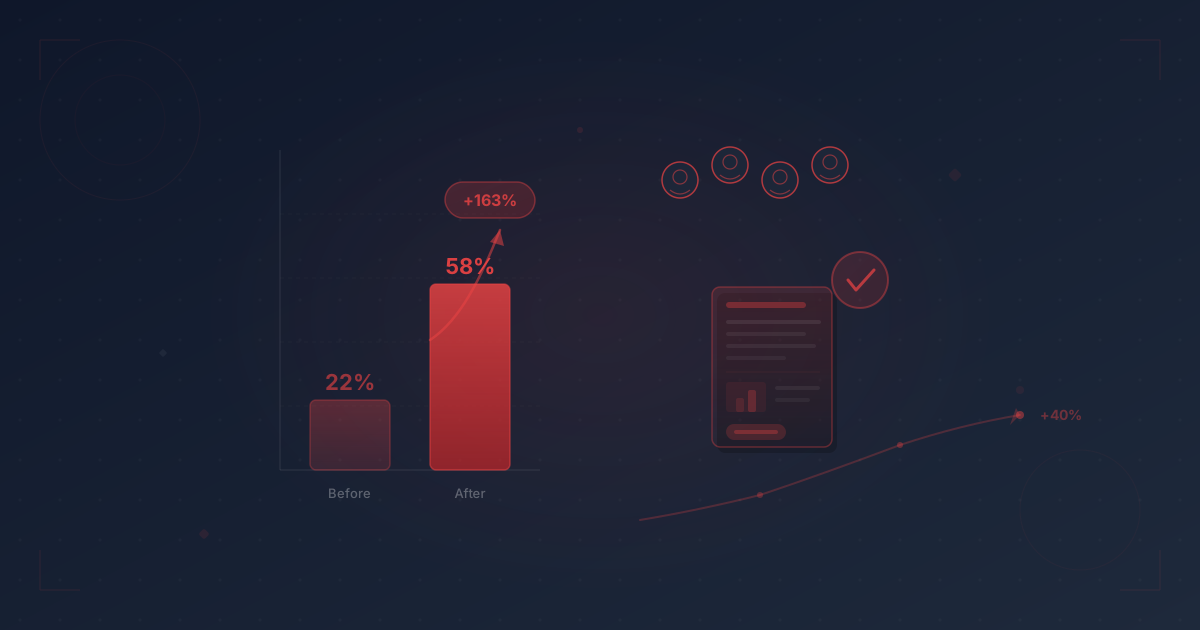
Case Study: Marketing Agency Increases Close Rate From 22% to 58%How a 4-person marketing agency increased their close rate from 22% to 58% — through systematic proposal optimization, social proof, and follow-up automation.
Julius
1/31/2026