Case Studies
Case Study: How a Web Designer Won a €42,000 Project Against 5 Competitors
Julius
|January 28, 2026|12 min read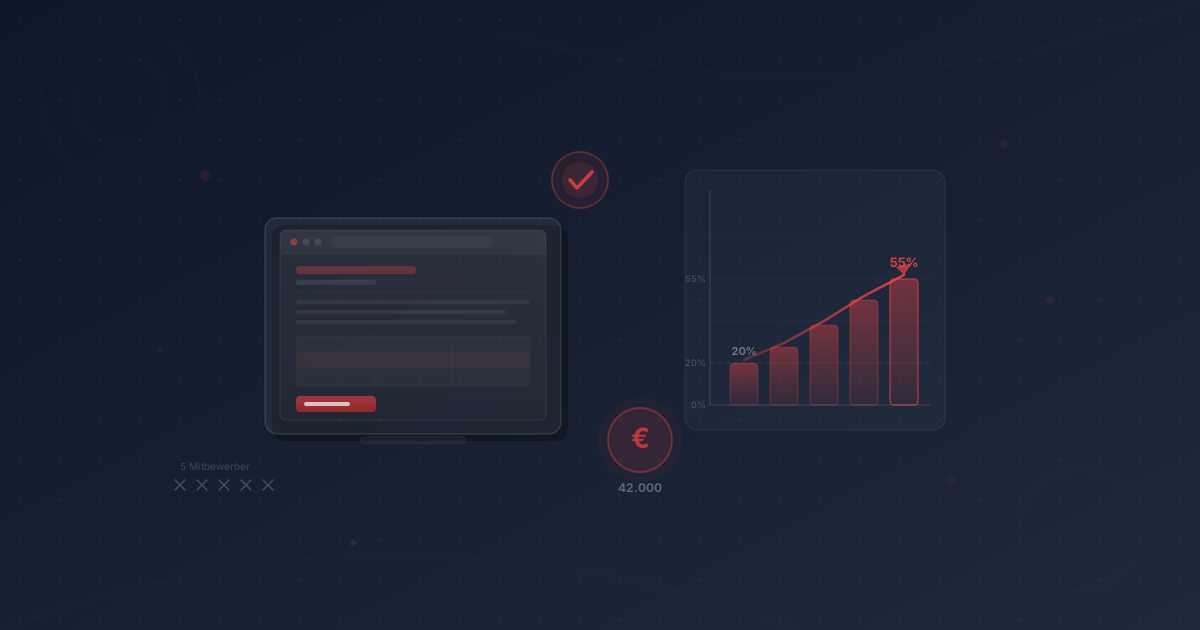
The Starting Point: All Effort, Little Return
Marco (name changed) is a freelance web designer based in Munich with 7 years of experience. His portfolio is strong: responsive websites, e-commerce shops, corporate redesigns. His technical skills are top-notch. Yet he had a serious problem.
Out of every 10 proposals he sent, only 2 came back with a yes. A conversion rate of 20% — well below the industry average of 35-45% for established freelancers.
In hard numbers, that meant:
- Average proposal value: EUR 8,500
- Proposals per month: 4-5
- Wins per month: approximately 1
- Monthly revenue: approximately EUR 8,500
- Time per proposal: 4-6 hours
Marco was investing 20-30 hours per month writing proposals, 80% of which ended up in the trash. This was not just emotionally draining — it was costing him real money. Every failed proposal represented 5 hours of unpaid work.
The Turning Point: An Honest Analysis
In January 2026, Marco decided to systematically analyze his last 15 proposals. He reached out to three former prospects and asked for honest feedback on why they chose someone else. The answers were uncomfortable but illuminating.
What the Clients Said
Client A (Agency, EUR 12,000 project): "Your proposal was technically excellent, but we couldn't see what the concrete benefit for us would be. The other provider showed us how the new website would increase our conversion rate by 30%."
Client B (Startup, EUR 6,000 project): "Honestly, your proposal read like a long feature list. We wanted to understand how you would solve our problem — not which technologies you use."
Client C (Mid-sized company, EUR 15,000 project): "We had 4 proposals. Yours was fairly priced, but the winner called after submitting, answered questions, and sent a reference. After your proposal, we heard nothing."
The Pattern Was Clear
Marco's proposals had three systematic weaknesses:
- Feature focus instead of value focus — He listed what he would build, not why it helps the client
- No visual trust — His proposals were plain text documents without professional layout
- No follow-up — After sending, he passively waited for a response
The New Strategy: 5 Concrete Changes
Marco overhauled his entire proposal process. Here are the five changes that made the difference.
Change 1: From Initial Call to Discovery Call
Before: 15-minute phone call, quick requirements gathering, proposal the next day.
After: Structured 45-minute discovery call with prepared questions:
- What is the specific business goal behind this project?
- How will you measure the success of the new website?
- What have you tried before, and why didn't it work?
- Who makes the decision, and what criteria matter most?
- What is your timeline, and what happens if you do nothing?
These questions gave Marco better information for the proposal — and they immediately positioned him as a consultant rather than a service provider. The client felt understood before the proposal was even written.
Change 2: Value Framing Instead of Feature Lists
Before: "Website redesign including 12 subpages, responsive design, WordPress CMS, basic SEO optimization, contact form, SSL certificate — EUR 8,500"
After: "Your new website will increase your online inquiries by an estimated 25-40% by optimizing user flow for conversions, bringing load times under 2 seconds, and visually anchoring your brand positioning as the quality leader in the region. Investment: EUR 8,500 — ROI within 4-6 months at your current inquiry rate."
The difference: Instead of an ingredient list, the client gets a picture of how the investment improves their business. Marco used a framework he applied consistently:
- Name the problem — What is the current situation costing the client?
- Sketch the solution — How exactly will you solve it?
- Quantify the result — What does it deliver in euros or percentages?
- Frame the investment — Not "costs" but "investment with ROI"
Learn more about value-based pricing in our guide to value-based pricing for proposals.
Change 3: Professional Proposal Design
Marco replaced his plain Word documents with structured, visually compelling proposals. The structure followed a clear layout:
Pages 1-2: Executive Summary A concise overview of the problem, the solution, and the expected result. So the decision-maker understands the core message in 60 seconds.
Pages 3-4: Problem Analysis Detailed assessment of the status quo with concrete numbers from the discovery call. The client should think: "He really understands where our pain points are."
Pages 5-7: Solution Concept No tech lists — instead, a visual project roadmap with milestones, timelines, and expected results per phase.
Pages 8-9: Investment and Options Three packages (Basic, Professional, Premium) with a clear recommendation. The three-tier structure leverages the decoy effect — the middle option is chosen almost every time.
Page 10: About Me and References Two to three relevant case studies with results and a brief statement about working style.
Find more tips on professional proposal design in our article on compelling proposal templates.
Change 4: Three-Step Follow-Up Process
Before: Send the proposal and wait.
After: A clear roadmap after submission:
- Day 1: Brief email: "The proposal is in your inbox. I'm available Thursday for questions — shall I schedule a quick call?"
- Day 4: Value-add follow-up: An additional idea or a relevant industry benchmark.
- Day 8: Reference follow-up: A concrete example of a similar project with result metrics.
This three-part process alone increased the response rate by over 50%. Clients who would never have replied suddenly got in touch — often saying, "Thanks for the reminder, we were still coordinating internally."
For detailed follow-up strategies and email templates, see our follow-up guide.
Change 5: Qualification Before the Proposal
Marco stopped writing proposals for every inquiry. Instead, he introduced a simple scoring system:
| Criterion | Points | |-----------|--------| | Specific budget mentioned | +3 | | Clear decision-maker identified | +2 | | Timeline defined | +2 | | Already comparing providers | +1 | | Came through referral | +2 | | Responds within 48 hours | +1 |
Below 5 points: No proposal — instead, a standard package offer or a polite decline. 5-7 points: Short proposal (2-3 pages). 8+ points: Full premium proposal.
This way, Marco invested his time only in inquiries with high close probability.
The EUR 42,000 Project: The Full Process
Three months after overhauling his proposal process, Marco received an inquiry that changed everything.
The Inquiry
A mid-sized industrial company near Munich (approximately 120 employees, B2B sector) was looking for a partner for a complete website redesign including a product configurator and integration with their ERP system. Budget: "in the five-figure range." Six providers were invited — three agencies and three freelancers.
The Discovery Call (Day 1)
Marco conducted his structured 45-minute call with the marketing director and the IT lead. He uncovered:
- The current website generated only 8 qualified leads per month
- Sales spent 40% of their time on manual quote requests that a configurator could automate
- A competitor had recently launched a new website and was pulling customers away
- The CEO wanted the project completed by Q3 — in 4 months
Marco's notes for the proposal: The pain point is not "new website" but "securing competitiveness and relieving the sales team."
The Needs Analysis (Days 2-3)
Marco requested access to Google Analytics and conducted a 90-minute analysis of the existing website. He summarized his findings in a two-page audit that he sent to the marketing director unprompted — free of charge, as a trust-building gesture.
The audit included:
- Current conversion rate: 0.8% (industry average: 2.5%)
- Top 3 drop-off pages with root cause analysis
- Estimated revenue potential if optimized: EUR 180,000-250,000 additional revenue per year
Those two pages were the decisive moment. The marketing director forwarded the audit to the CEO — Marco was no longer "one of six providers" but "the one who already analyzed our problem."
The Proposal (Day 5)
Marco structured his 12-page proposal using the new framework:
Executive Summary (1 page): "Your website is currently costing you an estimated EUR 180,000 in revenue per year due to a conversion rate that is 68% below the industry average. Our concept will raise your online lead generation from 8 to 25-30 leads per month and relieve your sales team by an estimated 15 hours per week through the integrated product configurator."
Three Package Options:
| | Basic | Professional | Premium | |---|---|---|---| | Website Redesign | 15 pages | 22 pages | 30+ pages | | Product Configurator | Simple | With ERP integration | With ERP + CRM | | SEO | Basic optimization | Full optimization | + Content strategy | | Training | 2 hours | 4 hours + video | 8 hours + ongoing support | | Investment | EUR 28,000 | EUR 42,000 | EUR 58,000 |
The recommendation was clearly marked as "Professional" — the package that covered all core requirements without exceeding the budget.
The Follow-Up Process (Days 6-14)
Day 6 (Email): "The proposal is with you. I have time Thursday between 2 and 4 PM for questions — shall I schedule a quick call?"
Day 9 (Email with added value): Marco sent a mini-analysis of the competitor who had recently relaunched: "I took a look at [Competitor]'s new website. Three things they are doing well — and two opportunities they missed that we can leverage for you."
Day 12 (Phone call): The marketing director called on his own. He had three questions about the configurator. Marco answered everything in detail and followed up with an updated page for the proposal.
The Win (Day 18)
On day 18 after submitting the proposal, Marco received the call: the contract was his for the Professional package — EUR 42,000. He had beaten two agencies and two other freelancers.
Why Marco Won
In the post-mortem conversation, the marketing director named three reasons:
-
"You understood our problem before we had fully articulated it." — The free audit built a level of trust that no other provider had established.
-
"Your proposal was the only one that quantified in euros what the current situation is costing us." — Value framing beat feature lists across all five competitors.
-
"Your follow-up was professional without being pushy." — The competitor analysis on day 9 demonstrated engagement and industry knowledge.
The Results in Numbers: Before vs. After
After 6 months with the new proposal process, Marco's dashboard looked like this:
| Metric | Before | After | Change | |--------|--------|-------|--------| | Conversion rate | 20% | 55% | +175% | | Average project value | EUR 8,500 | EUR 14,200 | +67% | | Proposals per month | 4-5 | 3-4 | -20% (intentional) | | Monthly revenue | ~EUR 8,500 | ~EUR 21,300 | +150% | | Time per proposal | 4-6 hours | 5-7 hours | +25% | | Revenue per proposal hour | ~EUR 340 | ~EUR 760 | +124% | | Referral rate | 10% | 35% | +250% |
The most important insight: Marco wrote fewer proposals than before but earned significantly more. The higher time investment per proposal (5-7 instead of 4-6 hours) was more than compensated by the drastically better conversion rate.
7 Lessons You Can Apply Today
1. Invest in the Discovery Call
A thorough initial conversation is not a waste of time — it is the foundation for a proposal that truly resonates with the client. Forty-five minutes of conversation saves you hours of rework and measurably increases your close rate.
2. Sell Outcomes, Not Deliverables
No decision-maker buys "12 subpages with responsive design." They buy "30% more online inquiries." Frame every deliverable as a benefit to the client's business.
3. Qualify Before You Invest
Not every inquiry deserves a 12-page proposal. A simple scoring system helps you invest your time in the right projects. Learn more in our guide to common proposal mistakes.
4. Offer a Taste of Your Work
Marco's free audit was not a gift — it was a strategic investment. It showed the client how Marco works and built trust that no competitor could match.
5. Structure Your Proposal for the Decision-Maker
Executive summary on page 1. Numbers and value before technology. Three options with a clear recommendation. The CEO who has only 5 minutes must be convinced just as much as the technical lead who reads every detail.
6. Follow-Up Is Not Begging
Marco's three-part follow-up process was the difference between "good provider" and "the provider we're going with." Each follow-up brought new value — not empty check-ins.
7. Track and Optimize Continuously
Marco now maintains a simple spreadsheet with: inquiry, score, proposal yes/no, follow-ups, outcome, feedback. After 6 months, he sees patterns he never would have recognized before.
Conclusion: The Process Makes the Difference
Marco's story shows that the difference between 20% and 55% conversion does not come down to price or technical skills. It comes down to the process: How you understand the client, how you communicate value, how you present the proposal, and how you follow up.
The good news: this process can be learned. Marco's five changes are not rocket science — but they require discipline and the willingness to honestly scrutinize your own proposal process.
Start with one thing: Take your last failed proposal and ask yourself — would the client have clearly understood what concrete benefit they would get for their money?
Further reading: How to design professional proposals · The 10 most common proposal mistakes · Follow-up strategies · Value-based pricing
Share
About the author
J
Julius
Julius is the founder of Proposal Air. As a former freelancer himself, he knows firsthand how much time proposals eat up — and is building the tool he always wished existed.
Create professional proposals in minutes
With Proposal Air, create stunning proposals — faster, more professional, and AI-powered.
No credit card required
Related Articles
Case Studies13 min
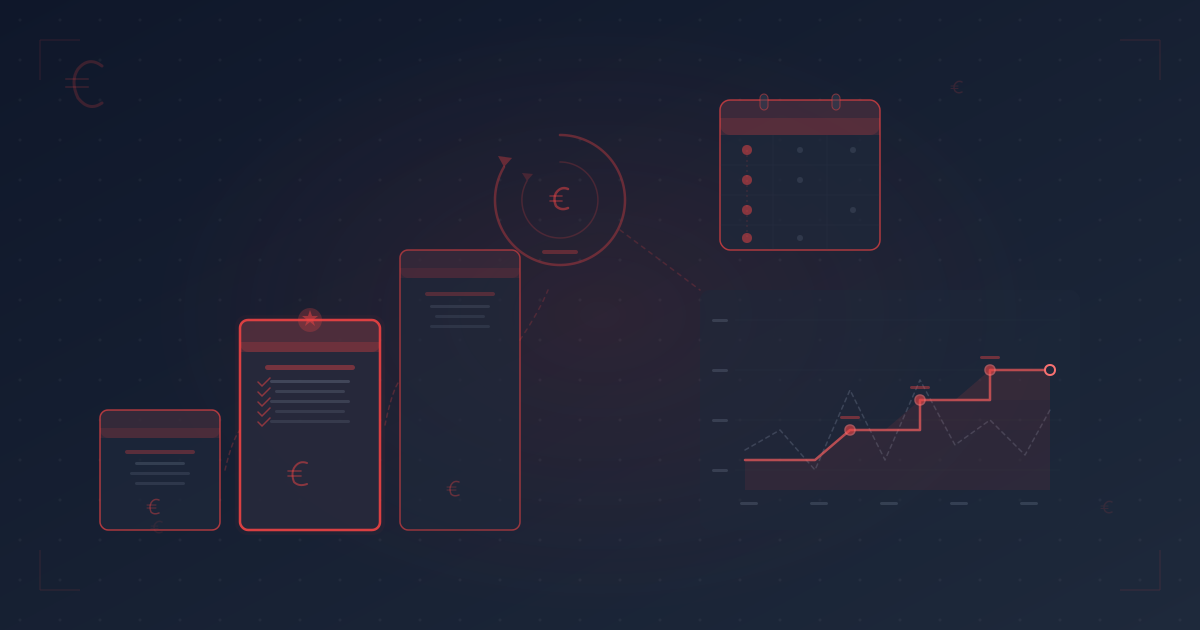
Case Study: IT Consultant Reaches €18,000/Month With Retainer ModelHow IT consultant Stefan went from unpredictable one-off projects to a predictable €18,000/month in retainer revenue — through strategic proposal design with tiered packages.
Julius
2/4/2026
Case Studies12 min
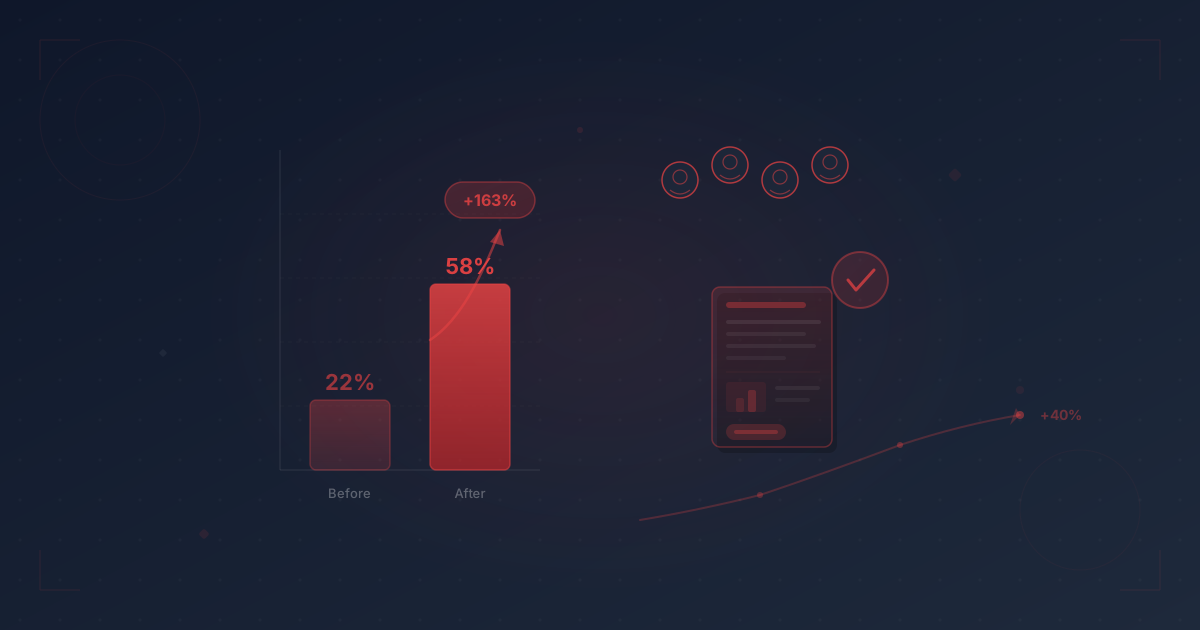
Case Study: Marketing Agency Increases Close Rate From 22% to 58%How a 4-person marketing agency increased their close rate from 22% to 58% — through systematic proposal optimization, social proof, and follow-up automation.
Julius
1/31/2026
Case Studies15 min
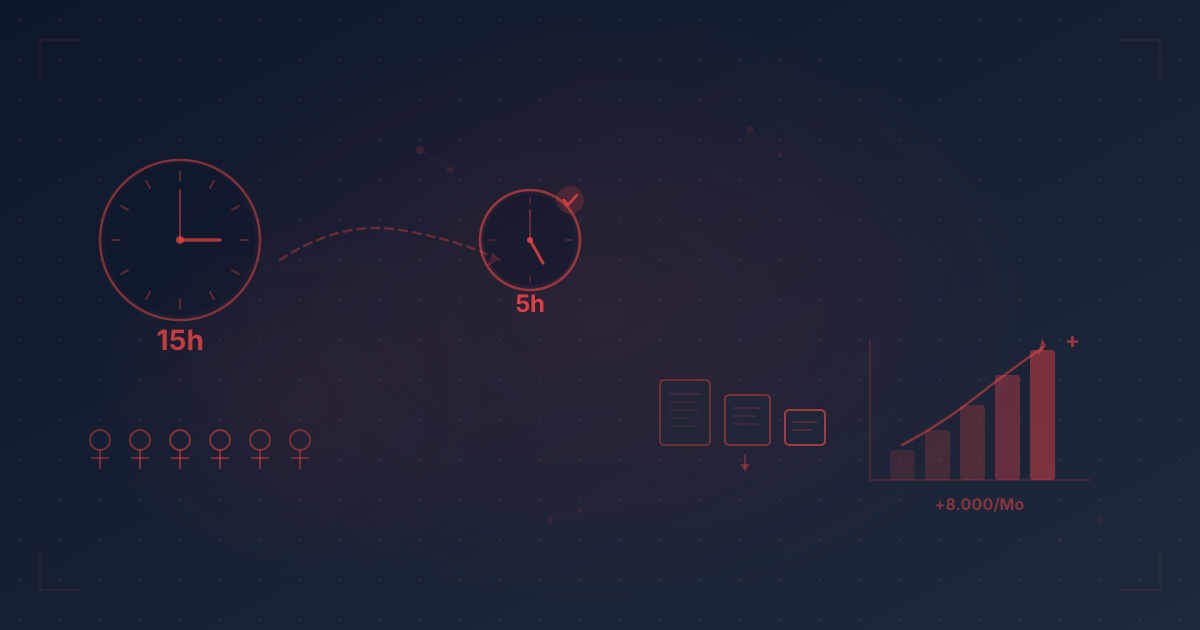
Case Study: Design Agency Saves 15 Hours Per Week on Proposal CreationHow a 6-person design agency reduced their proposal process from 15+ hours/week to under 5 hours — and turned the freed-up time into 8,000 euros/month in additional revenue.
Julius
2/11/2026