Proposals & Quotes
How to Write a Project Proposal: 7 Tips for Bigger Deals
Julius
|January 7, 2026|14 min read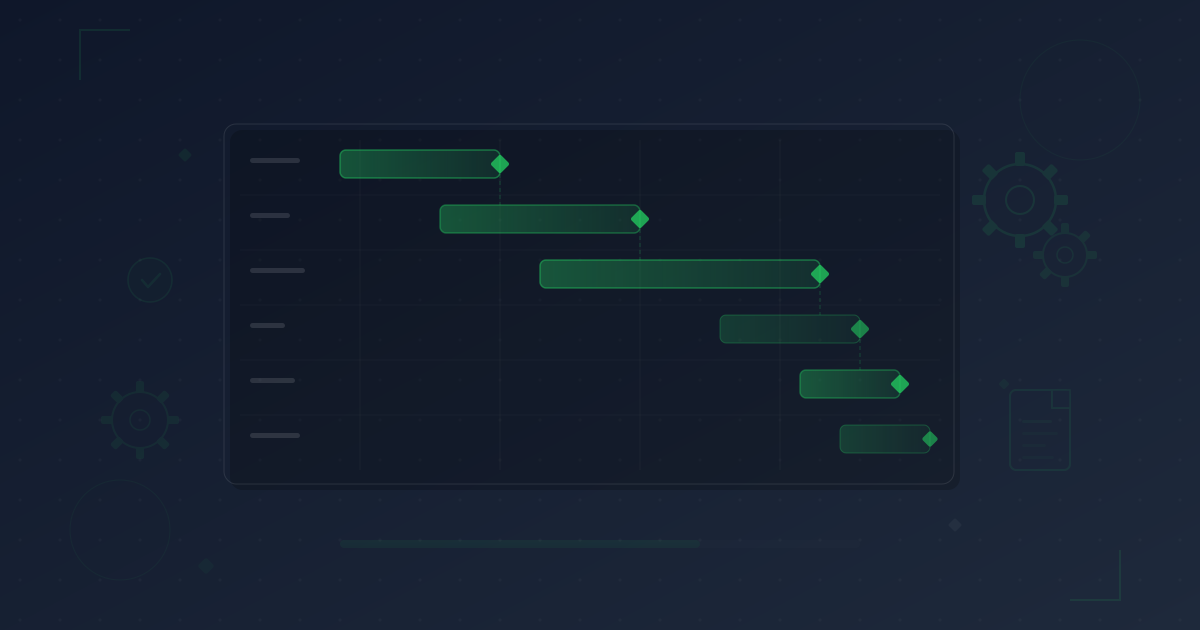
Why Large Projects Need Different Proposals
Writing a project proposal for a $500 job is straightforward: describe the work, name the price, done. But when the project volume climbs to $10,000, $50,000, or $100,000 and beyond, a simple scope description with a price list won't cut it.
Large projects bring bigger risks, more stakeholders, and more complex requirements. The client is investing a significant sum — and wants assurance that you have the project under control. Your proposal is the first proof of that.
In this article, I'll show you 7 strategies for writing professional project proposals for larger engagements — from needs analysis to client presentation. Each tip is based on real experience from IT, consulting, and creative projects.
1. Needs Analysis: Understand the Problem Before You Offer the Solution
The most common mistake in project proposals: jumping straight to the solution without understanding the actual problem. On a $50,000 project, this can cost you the deal — or worse, you win the deal and deliver something the client doesn't need.
The Discovery Meeting
Before you write a single line of your proposal, you need a structured discovery meeting. Allow 60 to 90 minutes and prepare specific questions:
- Business goals: What should the project achieve for the company? (Revenue growth, cost reduction, new markets?)
- Pain points: What isn't working right now? What does the problem cost the client?
- Stakeholders: Who is involved in the project? Who makes the final decision?
- Budget range: Does the client have a budget in mind? (Not always appropriate to ask directly, but try to narrow it down.)
- Timeline: Is there a hard deadline? Why now?
- History: Were there predecessor projects? Why wasn't this solved internally?
Document the Needs Analysis
Summarize your findings in a brief document — a briefing document. Send it to the client for confirmation before you write the proposal.
This step has two benefits:
- You avoid misunderstandings before they become expensive
- The client sees that you listen and work in a structured way
Pro tip: Frame the problem statement in the proposal using the client's own words. If the CEO said "We're losing 30 leads every month because our form doesn't work," use exactly that — not your technical paraphrase.
2. Scope Definition: What's In — and What's Explicitly Not
The larger the project, the more important a crystal-clear scope definition becomes. "Scope creep" — the gradual expansion of project scope — is the number one profitability killer for large projects.
In-Scope vs. Out-of-Scope
Divide your scope into three areas:
| Area | Description | Example | |------|-------------|---------| | In-Scope | What's included in the proposal | Web app development, 3 revision rounds, deployment | | Out-of-Scope | What's explicitly NOT included | Content creation, SEO, ongoing maintenance | | Optional | Add-on services with separate pricing | Maintenance contract (from $X/month), SEO optimization (+$X) |
The out-of-scope list is just as important as the in-scope list. It protects you from the dreaded "I thought that was included."
Prioritize Requirements
Use the MoSCoW method to prioritize requirements:
- Must have — Without these features, the project has no value
- Should have — Important, but the project works without them
- Could have — Nice to have if budget and time allow
- Won't have (this time) — Consciously excluded, potentially Phase 2
This prioritization helps you split the project into phases. And it gives the client the feeling that you're not trying to sell everything at once, but thinking strategically.
Change Request Process
Define in the proposal how change requests are handled. A simple process:
- Client describes the change request in writing
- You assess effort and impact on timeline and budget
- Client approves the amendment (or doesn't)
- Changes are only implemented after approval
Sounds bureaucratic? It is. But on an $80,000 project, this process saves your margin. Without a change request process, you pay for every "small change" out of your own pocket.
3. Risk Management: Show That You Think Ahead
No project goes 100% according to plan. The difference between a junior and a senior proposal writer: the senior names the risks openly — and shows how they'll handle them.
Risk Matrix in the Proposal
Create a simple risk matrix with the three to five most likely risks:
| Risk | Probability | Impact | Mitigation | |------|------------|--------|------------| | Client deliverable delays | High | Medium | Defined deadlines + escalation path | | Technical complexity underestimated | Medium | High | 20% time buffer + sprint reviews | | Stakeholder change on client side | Low | High | Document all decisions | | Third-party system dependency | Medium | Medium | Early API testing + fallback plan |
Why Naming Risks Builds Trust
Many freelancers are afraid to name risks in their proposal — they think it looks uncertain. The opposite is true: a client who has commissioned several large projects knows risks exist. If you ignore them, you look naive. If you name them and show mitigation strategies, you look professional.
Pro tip: Always frame risks as "Risk followed by Mitigation" pairs. Never leave a risk standing without a solution. This demonstrates competence and initiative.
4. Milestone Planning: The Backbone of Your Project Proposal
A large project without a milestone plan is like a road trip without navigation — you might arrive, but nobody knows where you are along the way.
Build a Phase Model
Divide the project into logical phases. A typical phase model:
Phase 1: Discovery & Concept (Week 1-2)
- Kick-off workshop
- Requirements analysis
- Technical concept / wireframes
- Milestone: Concept sign-off
Phase 2: Implementation (Week 3-8)
- Sprint 1: Foundation + core features
- Sprint 2: Extended features
- Sprint 3: Integration + testing
- Milestone: Feature-complete
Phase 3: Testing & Launch (Week 9-10)
- QA and bug fixing
- User Acceptance Testing (UAT)
- Go-live preparation
- Milestone: Go-live
Phase 4: Post-Launch Support (Week 11-14)
- Monitoring and performance optimization
- Bug support (defined scope)
- Handover and documentation
- Milestone: Project close-out
Milestones as Payment Triggers
Link milestones to payments. This is standard practice for large projects and protects both sides:
| Milestone | Payment | Timing | |-----------|---------|--------| | Contract signed | 20% deposit | Project start | | Concept sign-off | 20% | End of Phase 1 | | Feature-complete | 30% | End of Phase 2 | | Go-live | 20% | End of Phase 3 | | Project close-out | 10% final payment | End of Phase 4 |
This way you avoid having completed 80% of the project but only been paid 20%. And the client stays in control — they only pay when a defined deliverable is achieved.
5. Pricing: From Gut Feeling to a Transparent Price Structure
For small jobs, a flat rate is fine. For large projects, the client wants to understand how the price is composed. Transparent pricing isn't a sign of weakness — it's a sign of professionalism.
Bottom-Up Pricing
Calculate from the bottom up, not from the top down:
- Define work packages — Each work package has a clear deliverable
- Estimate effort — In hours or days, realistically (not optimistically!)
- Apply your rate — Your calculated hourly rate
- Add risk buffer — 15-25% depending on project complexity
- Account for overhead — Project management, communication, tools
- Include profit margin — Don't forget: you're a business owner, not an employee
Example Pricing Breakdown
Work Package                    Effort      Rate       Total
─────────────────────────────────────────────────────────────
Concept & Wireframing           24h        $130/h     $3,120
UI/UX Design                    40h        $130/h     $5,200
Frontend Development            80h        $130/h     $10,400
Backend Development             60h        $130/h     $7,800
Testing & QA                    20h        $130/h     $2,600
Project Management              16h        $130/h     $2,080
─────────────────────────────────────────────────────────────
Subtotal                                              $31,200
Risk Buffer (20%)                                      $6,240
─────────────────────────────────────────────────────────────
Total Investment (excl. tax)                          $37,440
Pricing Models for Large Projects
Not every project needs a fixed price. Here are the common models:
- Fixed price: Clear scope, both sides share risk. Good for well-defined requirements.
- Time & Materials (T&M): Billed by effort. Good for unclear scope. Offer a cap (ceiling).
- T&M with cap: A combination — you bill by effort, but the total doesn't exceed the cap. Fair for both sides.
- Hybrid: Phase 1 (Discovery) on T&M, Phase 2 (Implementation) as fixed price. Very common in IT projects.
Whichever model you choose: explain in the proposal why you recommend it. This shows you're not just picking a number, but pricing strategically. Deepen your pricing knowledge with our article on value-based pricing.
6. Stakeholder Management: Involve All Decision-Makers
On small projects, you talk to one person who also decides. On large projects, the landscape is different: there's the project manager, the budget owner, the IT director, sometimes the CEO — and each has different priorities.
Create a Stakeholder Map
Before writing the proposal, identify all relevant stakeholders:
- Decision Maker: Who gives the final GO? This person must find your proposal compelling.
- Budget Owner: Who controls the budget? Not always the same as the decision maker.
- Subject Matter Experts: Who provides input and accepts deliverables?
- Influencers: Who has no formal authority but gets asked informally?
- End Users: Whose daily work changes because of the project?
Tailor the Proposal to Each Stakeholder
Different stakeholders read your proposal differently:
| Stakeholder | Primarily reads... | Needs... | |------------|-------------------|----------| | C-Suite | Executive summary, investment | ROI, business case | | Project Manager | Scope, milestones, risks | Detailed planning, methodology | | IT Leadership | Technical concept, architecture | Tech stack, security | | Procurement | Pricing, payment terms | Comparability, conditions |
Pro tip: Structure your proposal so the executive summary fits on one page. The CEO often reads only this one page. Everything important must be there: problem, solution, investment, timeline.
The Underestimated Factor: Office Politics
In larger organizations, internal politics exist. Maybe the IT director has a different favorite vendor. Maybe the budget was contested internally. You can't control these dynamics, but you should be aware of them.
In the discovery meeting, subtly ask questions like:
- "Who else is involved in the decision?"
- "Are there internal constraints I should know about?"
- "Are you evaluating other providers as well?"
The better you understand the decision-making structure, the more precisely you can position your proposal.
7. Presentation: Present Your Proposal in Person
For small jobs, you send the proposal by email. For large projects, you should present it in person — or at least via video call. Why? Because a PDF alone can't answer every question, and in a live conversation you can address objections immediately.
Structure the Presentation
Plan 30 to 45 minutes for the presentation, divided into:
- Problem understanding (5 min) — Show that you understand the client's problem. Use their own words.
- Solution approach (10 min) — Explain your concept. Not too technical, not too abstract.
- Milestone plan (5 min) — Show the timeline. Visualize phases and milestones.
- Investment (5 min) — Walk through the pricing openly. Explain the price structure.
- Risks & mitigation (5 min) — Show that you think ahead.
- Questions & discussion (10-15 min) — The most important part. This is where the real persuasion happens.
Visuals Beat Text
For the presentation, create a compact slide deck in addition to the written proposal:
- Maximum 10-15 slides — Less is more
- One idea per slide — No walls of text
- Visualize the timeline — Gantt chart or simple timeline
- Show references — Similar projects you've successfully delivered
- End with next steps — What happens after the meeting?
Anticipate Objections
The most common objections on large projects — and how to address them:
- "That's more expensive than expected." — Walk through the pricing. Explain the risk buffer. Offer a phased approach.
- "Can you do it faster?" — Show what changes with a faster timeline (reduce scope or add resources = higher cost).
- "We're still comparing other providers." — Completely normal. Ask when the decision will be made and offer to clarify any open questions.
- "Can you provide references?" — Ideally, these are already in your proposal. Additionally offer to arrange a reference call.
Checklist: Your Project Proposal at a Glance
Before you send your proposal, run through this checklist:
Content
- [ ] Executive summary on one page
- [ ] Problem statement framed in the client's language
- [ ] Scope clearly defined (in-scope + out-of-scope + optional)
- [ ] Milestone plan with phases and timeline
- [ ] Detailed pricing with work packages
- [ ] Risk matrix with mitigation strategies
- [ ] Payment schedule tied to milestones
- [ ] Change request process described
- [ ] Next steps and call-to-action
Form
- [ ] Professional branding (logo, colors, formatting)
- [ ] Error-free language (proofread!)
- [ ] Validity period stated (14-30 days)
- [ ] Legal requirements complete
- [ ] Digital signature or acceptance option
Strategy
- [ ] All relevant stakeholders addressed
- [ ] Pricing model appropriate for the project type
- [ ] References or case studies included
- [ ] Presentation meeting scheduled
Common Mistakes in Project Proposals — and How to Avoid Them
Even experienced freelancers make mistakes on large projects. Here are the most common ones I see in practice:
1. Writing the Proposal Too Quickly
You get an inquiry and want to deliver fast. Understandable, but dangerous. Without thorough needs analysis, your proposal is based on assumptions — and assumptions are expensive.
Rule: No proposal without a prior discovery meeting. Even if the client pushes.
2. Not Documenting the Scope
"But we discussed that" is the most expensive sentence in project work. If it's not in the proposal, it doesn't exist.
Rule: Everything that's agreed upon goes into the document. Especially the out-of-scope items.
3. No Buffer in the Estimate
You estimate 200 hours and end up needing 260. That's 30% more effort at the same price. On a $40,000 project, that's $12,000 out of your pocket.
Rule: Minimum 15% risk buffer. For new clients or unclear scope: 20-25%. Learn more in our article on the 10 most common proposal mistakes.
4. Selling Only on Price
If your proposal is nothing more than a price list, the client compares you purely on price — and there's always someone cheaper.
Rule: Sell the value, not the price. Show ROI, reduced risks, and long-term benefits.
5. No Follow-Up After Sending
You send the proposal and wait. And wait. 47% of all proposals never get a response — not because the client isn't interested, but because they get buried in their day-to-day.
Rule: Follow up politely after 3-5 days. After 10 days, suggest a specific meeting time. Find more strategies in our article on proposal follow-up.
Conclusion: Big Projects Need Big Proposals
A project proposal for a major engagement isn't a cost estimate — it's a strategic sales document. It shows the client that you understand their problem, have a plan, and can manage the risks.
The seven building blocks at a glance:
- Needs analysis — Understand the problem before offering the solution
- Scope definition — Clearly define what's in and what's not
- Risk management — Name risks and show mitigation strategies
- Milestone planning — Structure the project in phases with payment triggers
- Pricing — Calculate transparently and bottom-up
- Stakeholder management — Address all decision-makers individually
- Presentation — Present your proposal in person
The more professional your proposal, the higher your close rate — and the fewer problems during the project. Invest the time in a thorough proposal. It pays off.
Related reading: Freelance Proposal Templates: 5 Professional Samples · Value-Based Pricing in Proposals · 10 Proposal Mistakes to Avoid · How to Calculate Your Freelance Hourly Rate
Share
About the author
J
Julius
Julius is the founder of Proposal Air. As a former freelancer himself, he knows firsthand how much time proposals eat up — and is building the tool he always wished existed.
Create professional proposals in minutes
With Proposal Air, create stunning proposals — faster, more professional, and AI-powered.
No credit card required
Related Articles
Proposals & Quotes6 min
Value-Based Pricing for Freelancers: How to Price Your Proposals by ResultsEscape the hourly rate trap: How value-based pricing helps you earn more and attract better clients. With formulas, examples, and proposal templates.
Julius
12/19/2025
Proposals & Quotes16 min
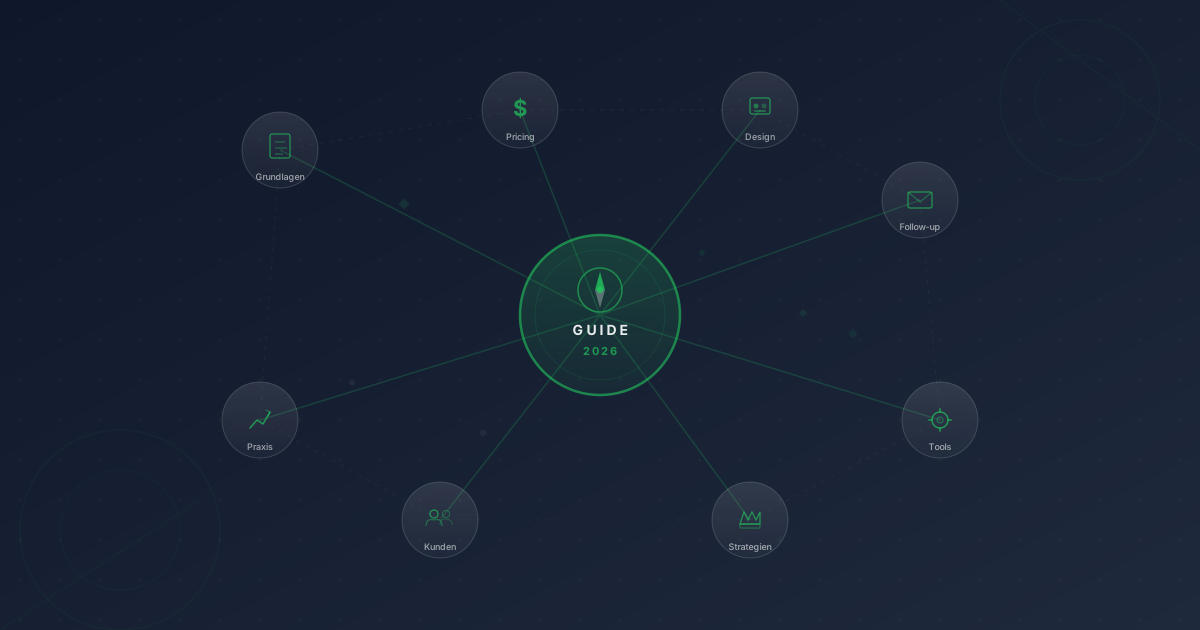
Proposal Strategy for Freelancers: The Complete Guide (2026)Everything freelancers need to know about proposals — from initial inquiry to winning the deal. The comprehensive guide linking to all specialist topics.
Julius
2/28/2026
Proposals & Quotes11 min
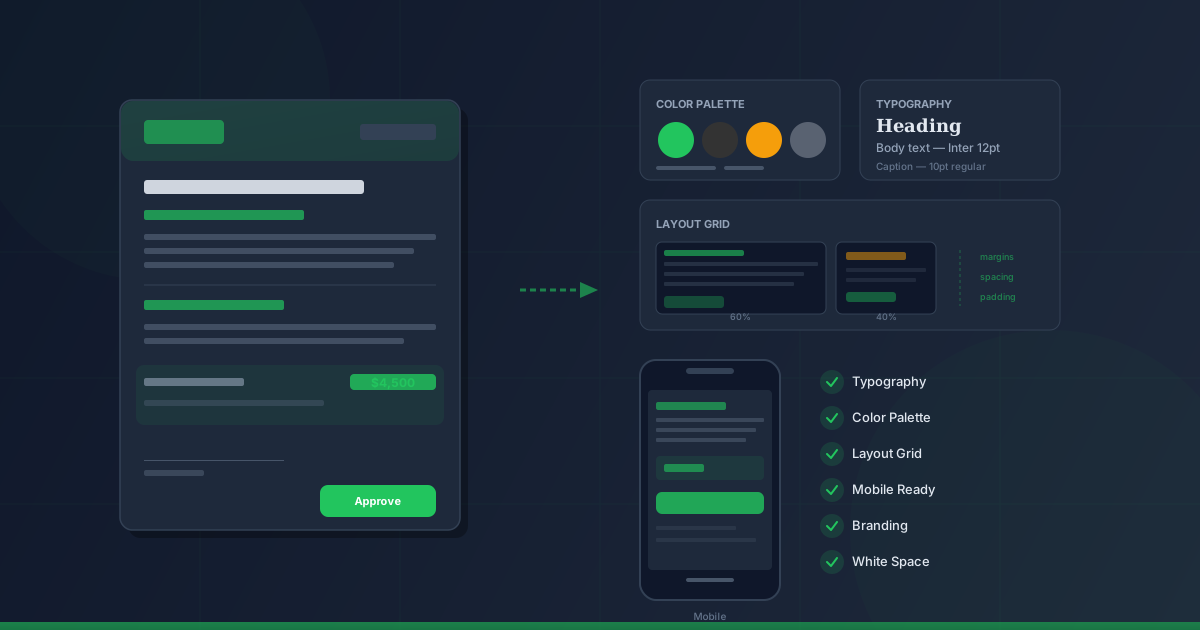
Professional Proposal Design: 9 Tips That Win ClientsLearn how to design proposals that win clients — from typography and color choices to layout and branding. Design tips that actually sell.
Julius
12/30/2025