Proposals & Quotes
Proposal Strategy for Freelancers: The Complete Guide (2026)
Julius
|February 28, 2026|16 min read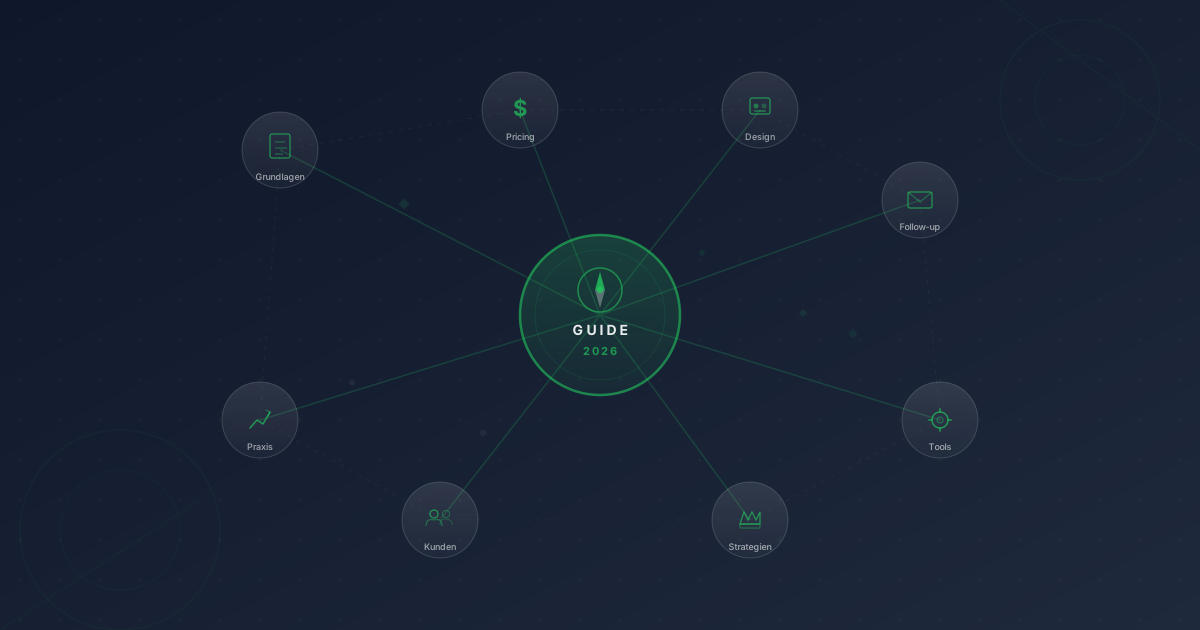
Why Your Proposal Strategy Determines Your Freelance Success
The numbers are clear: freelancers with a deliberate proposal strategy achieve conversion rates of 40-60%. Freelancers without a strategy hover at 10-20%. The difference? Not talent, not experience, not the lowest prices — but a system.
An average freelancer spends 3-5 hours per week creating proposals. At an hourly rate of $100, that is up to $25,000 per year invested in proposals. If every second proposal wins, this investment pays off. If only one in five proposals becomes a project, you are burning money.
This guide is the central hub for all proposal-related topics. Each chapter gives you a solid overview and links to the corresponding specialist article where you can dive deeper. Read the guide top to bottom for the full strategy, or jump directly to the chapter that interests you most.
Because the truth is: your proposal is not just a document. It is your most important sales tool. It determines whether an initial conversation becomes a project, whether you get paid fairly, and whether the client wants to work with you long-term. Those who leave their proposal strategy to chance also leave their income to chance.
What you will learn in this guide:
- Fundamentals of professional proposals and proven templates
- Pricing strategies from hourly rates to value-based pricing
- Design and presentation that build trust and sell
- Follow-up systems that secure deals instead of losing them
- Tools and AI automation for greater efficiency
- Advanced strategies for retainers and large projects
- Client acquisition, LinkedIn outreach, and scaling
- Five documented real-world case studies from various industries
Chapter 1: The Fundamentals — What Makes a Good Proposal?
Before you think about strategy, the basics need to be solid. A professional proposal is not a price tag — it is a sales document. It shows the client that you understand their problem, have a clear plan, and are the right choice.
The 7 Essential Elements
Every proposal you send needs at least these building blocks:
- Summary of the client's problem — Show that you listened. Restate the brief in your own words.
- Your solution approach — Not just what you do, but why you do it that way.
- Detailed scope of work — What is included, what is not? Clear boundaries protect against scope creep.
- Timeline with milestones — When do you deliver what? This gives the client planning certainty.
- Investment and pricing structure — Transparent, comprehensible, with a clear total price.
- About you and references — Brief, relevant, with social proof.
- Next steps — A clear call to action. What should the client do now?
The order is intentional: you lead the client from their problem to your solution and close with a clear call to action.
For a detailed walkthrough of each element, see our fundamentals article: How to Write a Freelance Proposal: The Complete Guide. It covers the structure step by step and shows you how to craft each element.
Templates as a Starting Point
You do not need to reinvent the wheel. Professional templates save you hours and ensure you do not forget anything. The key is to customize the template for your business and for each individual client.
We have compiled 5 industry-specific templates — for web design, consulting, IT, marketing, and copywriting: Freelance Proposal Templates: 5 Professional Samples.
If you specifically create service proposals — selling your expertise rather than physical products — you will find suitable samples and phrasing in this article: Service Proposal Templates: Professional Samples.
The Most Common Mistake
Most freelancers write proposals that revolve around themselves: "I offer...", "My experience...", "I will...". Successful proposals flip this. They start with the client, their problem, and their desired outcome. Only then comes your solution.
Chapter 2: Pricing Strategies — Finding the Right Price
Price is the most emotional element of your proposal. Too high, and the client drops off. Too low, and you work below your value — or the client becomes suspicious, because quality has its price.
Hourly Rate vs. Fixed Price vs. Value-Based
There are three fundamental pricing models for freelancers:
Hourly rate: Transparent, easy to calculate, but you directly trade time for money. The more efficient you become, the less you earn — a paradox. Hourly rates work best for projects with unclear scope or ongoing support.
How to correctly calculate your hourly rate — including all costs, vacation days, and profit margin — is explained in our specialist article: How to Calculate Your Freelance Hourly Rate.
Fixed price: The client knows exactly what they will pay. This creates planning certainty on both sides. Your risk: if the project takes longer than planned, your effective hourly rate drops. Your advantage: if you work efficiently, it rises.
Value-based pricing: You charge not by effort, but by the value you create for the client. A conversion optimizer who increases revenue by $50,000 can charge $10,000 — regardless of whether they need 20 or 200 hours. This model requires experience and confidence, but offers the highest income potential.
How to implement value-based pricing in your proposals is covered here: Value-Based Pricing in Proposals: Sell Results, Not Hours.
Quote or Proposal?
Many freelancers use the terms interchangeably — but legally and strategically, there are important differences. A proposal is binding, a quote is an estimate. When to use which format and what consequences that has is explained in this article: Quote vs. Proposal: What Freelancers Need to Know.
Package Pricing and Options
A proven strategy is the three-tier approach: offer three packages — Basic, Standard, and Premium. This gives the client choices and shifts the decision from "Should I buy?" to "Which package fits me?". Psychologically, this leads to higher close rates and higher deal values, because most clients choose the middle package.
The Golden Rule of Pricing
Never state the price without context. Show the value first, then the price. When the client understands what they are getting and what outcome to expect, the price feels smaller than feared. Place the price after the scope description, not before. And always show the return on investment: "For an investment of $5,000, you receive a website that demonstrably generates 30% more inquiries."
Chapter 3: Design and Presentation — First Impressions Matter
Your proposal can be perfect in content — if it looks like a tax return, the client loses trust. Design is not a nice-to-have; it is a sales tool.
Why Design Sells
Studies show that professionally designed documents are perceived as more trustworthy. The first impression forms in 3-5 seconds. In that time, the client sees only one thing: your layout, your typography, your branding. Not your content.
The most important design principles:
- Use white space — Overcrowded pages look chaotic
- Maximum 2 fonts — Consistency beats creativity
- Use colors strategically — Your brand colors plus one accent color
- Use images and icons sparingly — Only where they add real value
- Clear hierarchy — Headings, subheadings, body text
9 concrete design tips that elevate your proposals to the next level are covered here: How to Design Professional Proposals: 9 Design Tips.
The 10 Most Common Mistakes
Knowing what works well is just as important as knowing what costs you deals. From missing next steps to overly generic phrasing to poor structure — most mistakes are avoidable once you know them.
The complete list with solutions is in: 10 Proposal Mistakes That Cost You Deals.
Chapter 4: Follow-Up — Staying on the Ball
You sent a great proposal. Then: silence. Days pass, no reply. Most freelancers wait passively — and lose the deal to someone who follows up.
Why Follow-Up Determines Winning and Losing
80% of deals close only after the 3rd to 5th contact. Yet 44% of freelancers give up after the first follow-up. This means: you have a structural advantage if you establish a follow-up system.
The ideal follow-up rhythm:
- Day 1-2 after sending: Brief email asking if the proposal arrived
- Day 5-7: Content-driven follow-up with added value (e.g., a relevant case study)
- Day 12-14: Friendly reminder about the validity period
- Day 21+: Final follow-up with an alternative question
Detailed templates and scripts for every phase are covered in: How to Follow Up on Proposals: 5 Email Templates That Work.
Automating Follow-Ups with AI
Manual follow-up is error-prone. You forget a touchpoint, write too late or too early. AI-powered follow-up systems solve this problem: they remind you at the optimal moment, suggest personalized messages, and track which proposals are still open. The result: 35% more conversions at 90% less time spent on follow-ups.
How to fully automate follow-ups and which tools to use is covered in: Automate Follow-Ups with AI: Never Forget a Proposal Again.
When the Client Declines
Not every proposal leads to a deal — and that is perfectly normal. What matters is how you handle rejections. A professional response to a decline can keep the door open for future collaboration. It demonstrates maturity and professionalism.
How to respond to rejections and even turn them into opportunities is explained here: How to Respond to Proposal Rejections Professionally.
Chapter 5: Tools and Automation — Faster and Better
If you create every proposal from scratch, you waste valuable hours. The right tools transform a 3-hour process into a 15-minute workflow — without sacrificing quality.
The Tool Landscape in 2026
The market for proposal software has evolved significantly in recent years. From simple template tools to AI-powered solutions, there is the right option for every need and budget.
A comprehensive comparison of the best proposal tools is available in our market overview: Proposal Software Comparison: The 10 Best Tools in 2026.
AI-Powered Proposal Creation
Artificial intelligence is fundamentally changing how proposals are created. Instead of spending hours on wording, you generate personalized proposals in minutes. The AI understands the context of the client brief and creates tailored copy that you only need to refine.
For a broad overview of AI tools in the freelance workflow, see: AI Tools for Freelancers: 12 Smart Assistants.
If you specifically want to learn how to go from briefing to finished proposal in 5 minutes using AI — step by step with concrete prompts and examples — read this hands-on article: AI-Powered Proposal Creation: Professional Proposals in 5 Minutes.
Alternatives to Established Players
If you currently use PandaDoc or Fiverr Workspace and are looking for alternatives that are better tailored to solo freelancers and the European market:
- PandaDoc Alternative: More Affordable and Better Options 2026 — for those who find PandaDoc too complex or too expensive
- Fiverr Workspace Alternative: Better Tools for Freelancers — for those looking to switch after the Fiverr rebrand
Automation Beyond Proposals
Proposal creation is just one part of the freelance workflow. If you want to automate your entire business — from bookkeeping to emails to project management — you will find a comprehensive guide here: Freelancer Automation: Save 10 Hours Per Week.
Chapter 6: Advanced Strategies
Once the fundamentals are solid and your proposal process is running, it is time for advanced strategies that stabilize your income and make your business predictable.
Project Proposals for Larger Engagements
Small jobs are the entry point — but larger projects bring security. Project proposals require a different approach: more detailed scope descriptions, milestone planning, risk management, and often a presentation to a decision-making panel.
How to create a compelling project proposal that works for complex requirements: How to Create Project Proposals: Winning Large Engagements.
Retainer Models for Predictable Income
The gold standard for freelancers: monthly recurring revenue through retainer agreements. Instead of acquiring new clients every month, you secure long-term partnerships with guaranteed revenue.
A retainer contract of $3,000 per month replaces 12 individual projects at $3,000 each per year — at a fraction of the sales effort.
The complete guide to building retainers is here: Retainer Model for Freelancers: Building Predictable Income.
Contracts and Legal Protection
A good proposal needs a good contract. Topics like liability limitations, usage rights, notice periods, and confidentiality belong in a professional freelance contract. Without a contract, you risk unpaid invoices, scope creep, and legal issues.
A template and the most important clauses are in: Freelance Contract Template: The Essential Clauses.
Chapter 7: Client Acquisition — Where Do Inquiries Come From?
The best proposal strategy is useless if no inquiries come in. Client acquisition and proposal strategy belong together — they are two sides of the same coin.
Finding Clients as a Freelancer
Most freelancers rely on referrals. That works — until it does not. A diversified acquisition mix protects you from dry spells and gives you control over your project volume.
The most important channels:
- Referrals and networking — still the strongest source
- Content marketing and SEO — long-term, scalable
- LinkedIn and social selling — active outreach with added value
- Freelance platforms — Upwork, Malt, Fiverr as entry points
- Cold outreach — direct, measurable, fast
A detailed guide with concrete templates for each channel is here: How to Find Freelance Clients: 8 Proven Strategies.
LinkedIn as an Acquisition Channel
LinkedIn has become the most important B2B channel for freelancers. Over 90% of decision-makers at companies are active on LinkedIn. With the right combination of profile optimization, content strategy, and warm outreach, you can win clients predictably — without spam and without awkward cold pitching. The key is to build trust first and then offer relevant solutions when the need becomes apparent.
How to systematically use LinkedIn for client acquisition is explained here: LinkedIn Acquisition for Freelancers: Win Clients Without Cold Outreach.
Systematizing Referral Marketing
65% of all freelance projects come through referrals — but only 12% of freelancers have a systematic referral program. Most simply hope that satisfied clients will recommend them. That is a missed opportunity. With a structured referral system, you turn chance into predictability: you ask at the right moment, offer the right incentive, and keep the relationship active.
How to build a referral system that delivers qualified leads regularly: Referral Marketing for Freelancers: Building a Systematic Referral System.
From Freelancer to Agency
When your order volume grows and you turn down projects because you lack capacity, the question arises: should I scale? The step from solo freelancer to agency is a big one — with opportunities and risks.
How to plan this transition, build your first team, and scale proposal processes for a team is covered in detail: Starting an Agency as a Freelancer: From Solo to Team.
Chapter 8: Real-World Success Stories
Theory is important — but nothing convinces like real results. We followed five freelancers and agencies and documented how they transformed their proposal processes.
Case Study 1: Web Designer Triples Project Volume
Tom, a self-employed web designer, had a problem: he wrote many proposals, but most went nowhere. After revamping his proposal strategy — more professional design, structured packages, systematic follow-up — his close rate rose from 15% to 48%. At the same time, his average project volume tripled because his proposals better communicated the value of his work.
The full story: Case Study: How a Web Designer Tripled His Project Volume.
Case Study 2: Agency Increases Close Rate by 42%
A 5-person marketing agency struggled with inconsistent proposals — every team member had their own style. By introducing standardized templates and a centralized proposal tool, close rates rose from 28% to 42%, while processing time per proposal dropped by 60%.
The full story: Case Study: How an Agency Increased Their Close Rate by 42%.
Case Study 3: IT Consultant Builds Retainer Model
Marcus, an IT security consultant, worked project-based for years. Every month started at zero. By introducing a retainer model — monthly security audits with a guaranteed minimum budget — he achieved predictable base income of $8,000 per month. The retainer clients were won through tailored proposals that demonstrated the long-term ROI of the collaboration.
The full story: Case Study: How an IT Consultant Switched to a Retainer Model.
Case Study 4: Copywriter Scales from Solo to Team
Lisa, a freelance copywriter, was overwhelmed with inquiries — but could not grow faster as a solo freelancer. Through an optimized proposal process with package pricing and gradual team expansion, she scaled her revenue from $4,000 to $18,000 per month in 12 months.
The full story: Case Study: How a Copywriter Scaled from Solo Business to Agency.
Case Study 5: Design Agency Saves 15 Hours Per Week
A 3-person design agency spent 15+ hours weekly creating proposals. By introducing Proposal Air and automated building blocks, processing time dropped to under 3 hours — with simultaneously better results, because the freed-up time flowed into client communication and follow-up.
The full story: Case Study: How a Design Agency Saves 15 Hours Per Week.
Conclusion and Checklist: Your Path to an Optimal Proposal Strategy
A deliberate proposal strategy is not a one-time task — it is a system that you build, test, and continuously improve. The good news: you do not have to implement everything at once. Start with the fundamentals and optimize step by step.
Your Proposal Strategy Checklist
Fundamentals (Week 1-2):
- Professional template created and customized to your branding
- All 7 essential elements present in every proposal
- Clear scope description with boundaries (what is not included)
- Legal basics: validity period, payment terms, tax information
Pricing (Week 3-4):
- Hourly rate correctly calculated (with all costs and profit margin)
- Pricing strategy chosen: hourly, fixed, or value-based
- Packages or options defined (good/better/best)
- Price always presented in the context of client value
Design (Week 5-6):
- Layout and typography professional and consistent
- Branding elements integrated (logo, colors, fonts)
- White space and hierarchy optimized
- The 10 most common design mistakes eliminated
Process (Week 7-8):
- Follow-up system with 4 touchpoints established
- Email templates for every follow-up phase created
- Professional response to rejections prepared
- Conversion rate tracked and regularly evaluated
Automation (Week 9-10):
- Proposal tool introduced (e.g., Proposal Air)
- Reusable building blocks and text modules created
- Bookkeeping and invoicing automated
- Workflow from inquiry to proposal documented
Scaling (from Month 3):
- Retainer models developed for existing clients
- Freelance contract standardized
- Client acquisition diversified (not just referrals)
- Regular optimization based on conversion data
You now have the complete overview of everything that belongs to a professional proposal strategy. Each chapter links to the corresponding specialist article where you can dive deeper. Start where you see the biggest lever — and work your way through piece by piece.
The most important step is the first one: open your last proposal, compare it against the standards from this guide, and identify three things you can improve immediately. Then get started.
Related articles: Proposal Templates for Freelancers · Value-Based Pricing in Proposals · Case Study: Web Designer Wins €42k Project · AI-Powered Proposal Creation
Share
About the author
J
Julius
Julius is the founder of Proposal Air. As a former freelancer himself, he knows firsthand how much time proposals eat up — and is building the tool he always wished existed.
Create professional proposals in minutes
With Proposal Air, create stunning proposals — faster, more professional, and AI-powered.
No credit card required
Related Articles
Proposals & Quotes3 min
How to Write a Freelance Proposal: The Complete Guide 2026Learn step by step how to write professional freelance proposals that win clients and boost your close rate.
Julius
11/18/2025
Proposals & Quotes11 min
Professional Proposal Design: 9 Tips That Win ClientsLearn how to design proposals that win clients — from typography and color choices to layout and branding. Design tips that actually sell.
Julius
12/30/2025
Proposals & Quotes6 min
10 Proposal Mistakes Costing You Clients (and How to Fix Them)Why aren't your proposals getting accepted? Probably because of one of these 10 mistakes. With concrete examples and immediately actionable fixes.
Julius
12/27/2025