AI & Automation
Automate Follow-Ups With AI: Never Forget a Proposal Again
Julius
|February 18, 2026|11 min read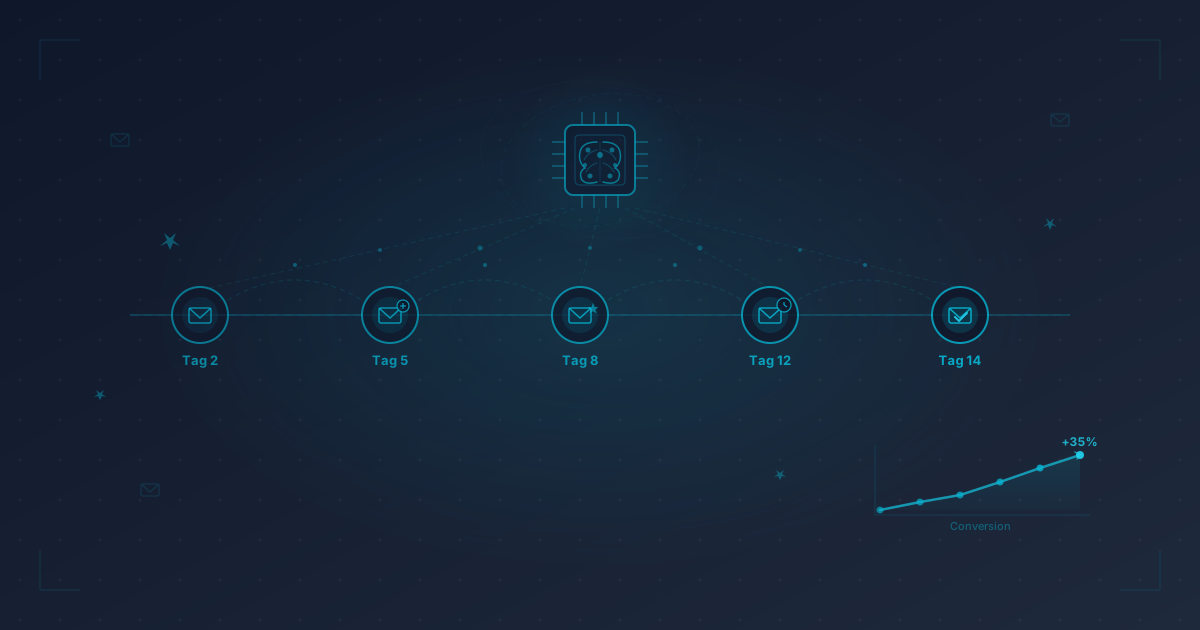
The $20,000 Problem: Why Freelancers Leave Money on the Table
Imagine you send out 10 proposals a month. Average value: $4,000. Three close without any follow-up. But the other seven? Radio silence.
Of those seven, at least one would say yes — if only you followed up. That is $4,000 a month. $48,000 a year. Gone, simply because no follow-up email went out.
The reality is sobering:
- 80% of freelancers don't follow up systematically
- 44% give up after the first contact attempt
- Yet 60% of clients say yes on the 2nd to 5th contact
- Only 8% of freelancers have a structured follow-up process
The problem is rarely unwillingness. It is forgetting, uncertainty, and lack of structure. You are deep in a new project, the deadline is pressing — and last week's proposal? Out of sight, out of mind.
This is exactly where AI-powered automation steps in. Not as a spam machine, but as an intelligent assistant that suggests the right message at the right time.
The Psychology of Follow-Ups: Why Silence Doesn't Mean No
Before we talk about tools and automation, we need to understand why clients don't respond. Because the assumption "no response = no interest" is wrong in most cases.
Why clients don't respond
1. Life gets in the way. Your proposal lands in their inbox between 47 other emails. The client reads it, likes it, intends to respond — and then the phone rings. Tomorrow it's on page 2 of the inbox. The day after, forgotten.
2. Decisions take time. Especially at higher price points (above $2,000), clients need to consult internally, check budgets, or ask a business partner. That takes time. And while they're waiting, they don't respond.
3. Uncertainty about next steps. Some clients simply don't know how to react. "Should I just write 'Yes'? Is there a contract? How does the deposit work?" Without a clear next step, they stay passive.
4. Comparing other proposals. The client has requested multiple proposals and wants to compare. Whoever follows up first stays top of mind — and simultaneously demonstrates commitment.
The key insight
Follow-ups are not begging. They are a service. You remind the client of a problem they wanted to solve. You make the decision easier. And you demonstrate reliability — a quality that matters just as much in the project as it does in the sales process.
For a deeper dive into the fundamentals of proposal follow-ups, check out our guide on crafting the perfect follow-up email with templates and proven frameworks.
The 5-Touchpoint Strategy: Your 14-Day Plan
Not every follow-up is created equal. The art lies in delivering different value with each contact — so you don't sound like a broken record.
Day 2: The Friendly Check-In
Goal: Confirm the proposal arrived and open the door for questions.
Sample subject line: "Quick question about my proposal"
Hi [Name], just wanted to make sure my proposal came through okay. If any questions came up or you'd like to adjust anything, I'm happy to chat.
Why it works: Low-pressure, no urgency, opens the dialogue.
Day 5: The Value-Add Follow-Up
Goal: Deliver additional value beyond the proposal itself.
Sample subject line: "Another idea for [Project Name]"
After our conversation, something occurred to me: [specific suggestion relevant to the project]. This could be implemented at no additional cost and might [specific benefit]. What do you think?
Why it works: You position yourself as a strategic partner, not a salesperson. The client sees that you genuinely care about their problem.
Day 8: Social Proof
Goal: Build trust through references and results.
Sample subject line: "Similar project — here's how it went"
I just wrapped up a similar project for [anonymized industry reference]. [One concrete result]. If that would be helpful for your decision, I'm happy to share more details.
Why it works: Reduces perceived risk. The client sees evidence, not just promises. As one case study demonstrates, social proof can dramatically increase close rates.
Day 12: The Soft Deadline
Goal: Create urgency without pressure.
Sample subject line: "Availability in [Month]"
Quick update: my availability for [Month] is filling up. If you'd like to move forward with the project, it would be great to lock in next steps by end of this week. No pressure — I just want to be transparent.
Why it works: Real capacity constraints are a legitimate reason for urgency. It comes across as professional, not manipulative.
Day 14: The Breakup Email
Goal: Give the client a conscious choice — and trigger a response surprisingly often.
Sample subject line: "Should I close out this proposal?"
Hi [Name], I don't want to be a pest — so here's my honest question: Has the project been shelved, or is the timing just not right? Either is completely fine. If something changes down the road, you're always welcome to reach out.
Why it works: Something fascinating happens psychologically. The breakup email signals that you won't wait forever. This creates a subtle fear of loss — and triggers a response in 15-25% of cases, often with an acceptance.
AI-Powered Personalization: Making Every Follow-Up Unique
The 5-touchpoint strategy provides the framework. But what makes it truly effective is personalization. And this is precisely where AI excels.
What AI can do for follow-ups
1. Context-aware drafting AI knows your proposal (services, pricing, project goals) and can tailor the follow-up accordingly. Instead of a generic reminder, you get an email that references specific points from the original conversation.
2. Tone matching The client used informal language in the initial conversation? AI picks that up. The communication was more formal? AI adapts. These details make the difference between "obviously automated" and "personally written."
3. Timing optimization AI systems can analyze when your emails are most frequently opened. Tuesday at 10 AM? Thursday at 2 PM? Automated sending at the optimal time increases open rates by 20-30%.
4. Conversion prediction Advanced systems score which proposals have the highest close probability — based on factors like response speed, proposal volume, and client behavior. This tells you where intensive follow-up pays off most.
Practical example: AI-powered follow-up
You wrote a proposal for a website redesign for a dental practice. Day 5 arrives. Instead of a generic email, AI generates:
Hi Ms. Smith, after our conversation, I noticed your current appointment booking is phone-only. Online booking could increase inquiries by 30-40% — and it would be easy to integrate into the redesign at no extra cost. Should I include that in the scope?
This email is specific, relevant, and helpful. The difference from "Did you receive my proposal?" is enormous.
For more ways to leverage AI in your freelance workflow, our comprehensive overview of AI tools for freelancers in 2026 covers every category.
Automation Setup: Step by Step
Theory is good, execution is better. Here is the concrete plan for setting up your follow-up system — from simple to advanced.
Level 1: Reminders (5-Minute Setup)
What you need: Proposal Air or a calendar
The bare minimum: For every proposal you send, set reminders for days 2, 5, 8, 12, and 14. In Proposal Air, this happens automatically — the system reminds you when a proposal hasn't been viewed or answered.
Time investment: 5 minutes one-time, 2 minutes per follow-up
Level 2: Templates + AI Drafts (30-Minute Setup)
What you need: Email templates + AI assistant (Claude, ChatGPT)
Create a template for each of the 5 touchpoints with placeholders. When a reminder fires, open the matching template, let AI fill the placeholders with context-aware content, and send.
Template example for Day 5:
Subject: Another idea for [PROJECT NAME]
Hi [GREETING],
[AI: generate a specific value-add suggestion
based on the proposal for PROJECT DESCRIPTION]
[AI: appropriate closing matching the tone of previous contact]
Time investment: 30 minutes setup, then 3-5 minutes per follow-up
Level 3: Full Automation (2-Hour Setup)
What you need: Proposal Air + CRM + email automation
The goal: The entire follow-up process runs automatically. Proposal sent? The sequence starts. Client opens the proposal? The trigger adapts. Client responds? The sequence stops.
The automation flow:
- Trigger: Proposal is sent via Proposal Air
- Day 2: Automatic check-in (personalized by AI)
- Mid-check: Did the client open the proposal? If yes: adapt the Day 5 email ("I noticed you've reviewed the proposal...")
- Day 5: Value-add follow-up (AI generates suggestion based on proposal content)
- Day 8: Social proof email (automatically select a matching reference)
- Day 12: Deadline email with current availability status
- Day 14: Breakup email
- Stop trigger: Client responds, proposal is accepted or declined
Time investment: 2 hours one-time, then virtually zero
When NOT to Follow Up: The Limits of Automation
Automation is powerful — but not without boundaries. There are situations where following up is counterproductive. Knowing these limits protects your reputation.
Respect clear rejections
When a client says "No, thanks," the conversation is over. No "But have you considered..." and no "last chance" emails. A friendly response ("Thanks for letting me know, I wish you all the best") — and done.
Respect industry norms
In some industries (government agencies, large corporations), there are formal procurement processes. Following up can appear unprofessional or even disqualify you. Do your homework.
Limit frequency
More than 5 contact attempts in 14 days is too many. If there is no response after the breakup email, silence is the right answer. The client has your contact details — if something changes, they'll reach out.
Tag automated messages (internally)
Even if the recipient can't tell: document internally which emails were automated and which were manual. This prevents awkward moments in personal conversations when you don't recall what "you" wrote.
Quality over quantity
One well-crafted follow-up works better than three hasty ones. Better to send one fewer email than to send one that adds no value.
Results: What Systematic Follow-Ups Deliver
The numbers tell a clear story. Freelancers and small agencies that implement a structured follow-up process consistently report significant improvements:
Typical results after 3 months
| Metric | Without Follow-Up System | With 5-Touchpoint Strategy | |--------|-------------------------|---------------------------| | Proposal response rate | 30-40% | 65-75% | | Conversion rate (proposal to project) | 15-25% | 35-50% | | Average decision time | 18 days | 9 days | | Forgotten follow-ups per month | 4-6 | 0 | | Time spent on follow-ups/week | 0 (nothing happens) | 30 min (automated) |
Why conversion rises by 35%
It is not a single factor but the combination:
1. Presence: You stay on the client's radar. While competitors go silent, you demonstrate commitment.
2. Trust building: Every meaningful touchpoint strengthens trust. The client thinks: "If this person is this reliable in sales, the project work will be solid too."
3. Decision support: Through value-add emails and social proof, you provide the client with the arguments they need for their internal decision.
4. Timing: Automated timing ensures your follow-up arrives exactly when the client is ready — not too early (annoying) and not too late (forgotten).
For a detailed analysis of how automation improves the entire freelance workflow, we recommend 10 hours a week saved with the right automation tools.
The Best Time to Start Is Now
You don't have to set up full automation today. Start with Level 1: Set five reminders for your next proposal. Use the 5-touchpoint strategy from this article. Measure the results.
When you see that a single follow-up brings in a response that would have never come otherwise — you'll know exactly what systematic follow-ups are worth. And then the investment in automation pays for itself many times over.
Because ultimately, it is not about sending more emails. It is about not leaving money on the table — professionally, respectfully, and with genuine value for the client.
Related reading: The Perfect Proposal Follow-Up Email · AI Tools for Freelancers 2026 · Case Study: Agency Boosts Close Rate to 58% · Freelancer Automation: Save 10 Hours/Week
Share
About the author
J
Julius
Julius is the founder of Proposal Air. As a former freelancer himself, he knows firsthand how much time proposals eat up — and is building the tool he always wished existed.
Create professional proposals in minutes
With Proposal Air, create stunning proposals — faster, more professional, and AI-powered.
No credit card required
Related Articles
AI & Automation13 min
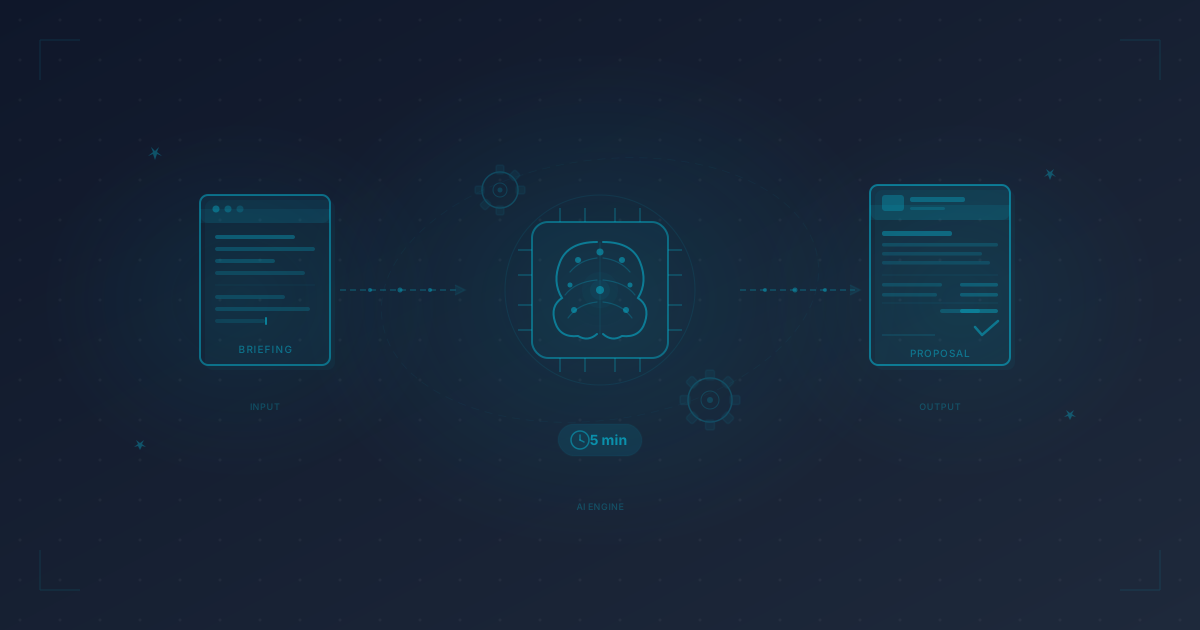
AI-Powered Proposal Creation: Professional Proposals in 5 MinutesHow to create professional proposals with AI in 5 minutes — step by step. From briefing input to automatic text generation to a ready-to-send proposal.
Julius
2/14/2026

AI & Automation6 min
AI Tools for Freelancers 2026: Automate Proposals, Content & WorkflowsThe best AI tools for freelancers in 2026: From automated proposals to content creation to accounting. With practical tips and pricing comparison.
Julius
12/16/2025
Case Studies12 min
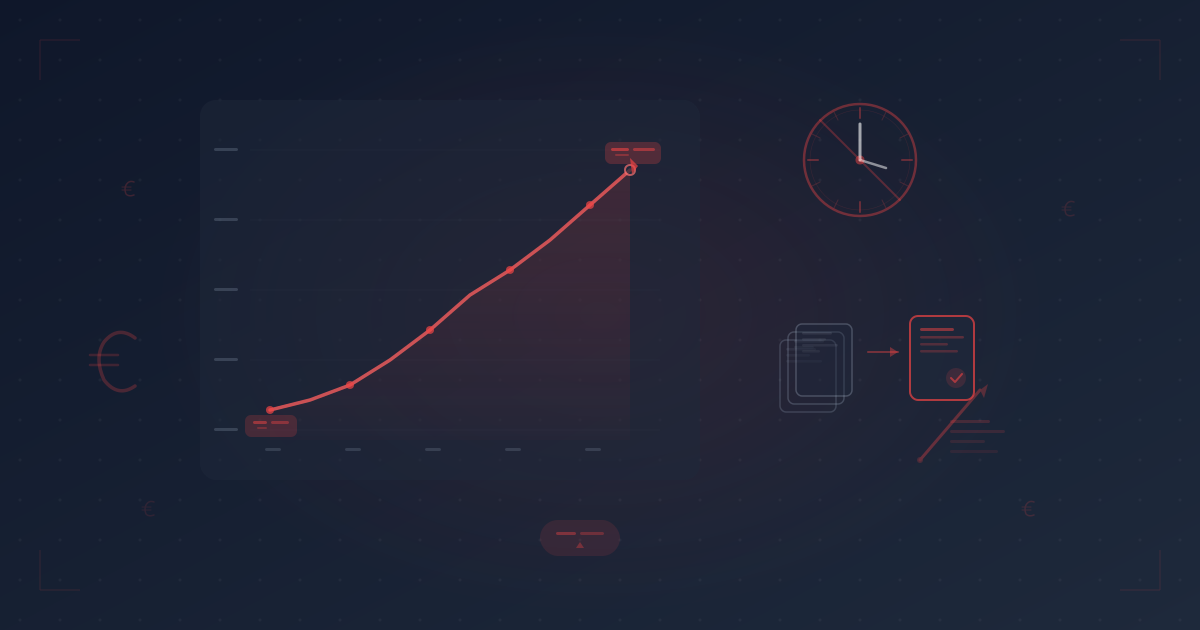
Case Study: How a Copywriter Scaled Revenue From €48k to €112kHow freelance copywriter Lisa scaled her revenue from €48k to €112k — through proposal automation, package pricing, and less admin work. The complete strategy.
Julius
2/7/2026